When the Bear Knocks Again: Russia’s Return to Afghanistan
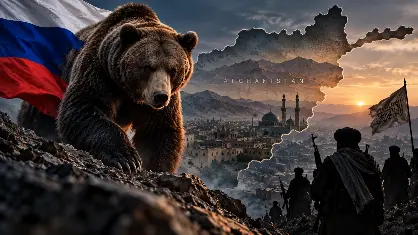
Russia’s renewed engagement with Afghanistan reflects Moscow’s growing interest in regional influence and security.
The last time the Russian bear knocked at Pakistan’s western door, it did not come for a conversation. It came through Afghanistan with tanks. The Soviet invasion of Afghanistan in 1979 changed Pakistan’s western frontier for more than a decade. Islamabad became a frontline state in the Cold War. Afghanistan became a battlefield between two larger systems. And Russia, then the Soviet Union, became the power sitting on the other side of Pakistan’s western border. Four decades later, the bear is back. But this time, it is not coming through the Khyber Pass. It is coming through diplomacy.
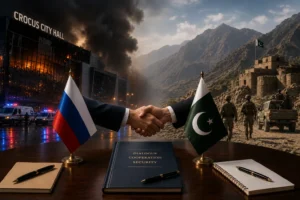
On October 5, Russia hosted the eighth Moscow Format meeting on Afghanistan, bringing together the Taliban, Pakistan, China, India, Iran and Central Asian states. Russian Foreign Minister Sergey Lavrov welcomed the Taliban delegation and spoke openly about Moscow’s expanding engagement with Kabul. Russia also offered its platform to help address the growing dispute between Pakistan and Afghanistan. Yet the meeting itself showed how difficult that balancing act has become. Pakistan and the Taliban could not agree on the language of the final statement, largely because of their disagreement over terrorism and Afghanistan’s alleged role in sheltering militant groups. No joint statement was issued.
This is where Russia’s return to Afghanistan becomes important for Pakistan. Because this is not 1979. Russia is not returning to occupy Afghanistan. It does not need to. The bear has changed its way of entering. For Moscow, Afghanistan was once a problem to be controlled. Today, it is a problem to be managed. The difference is important. Russia formally recognized the Taliban government in July 2025, becoming the first country to do so. In May 2026, Moscow and Kabul signed a military-technical cooperation agreement. The full details of the agreement are not public, but the development itself shows that Russia-Taliban relations have moved well beyond diplomatic contact.
Moscow has its reasons.
Afghanistan sits directly below Russia’s Central Asian security space. Whatever happens in Afghanistan does not necessarily remain in Afghanistan. Islamic State Khorasan, transnational militant networks, narcotics and instability along the Central Asian frontier remain concerns for Moscow. So Russia has chosen engagement with the Taliban. Not because the Taliban has suddenly become an ideological partner of Moscow. But because the Taliban controls Kabul. And Russia has learned something from the American experience in Afghanistan: ignoring the government in Kabul does not make Kabul irrelevant.
The new Russian approach is therefore simple. Talk to Kabul. Equip Kabul where useful. Keep regional powers around the same table. And make sure no outside power gets the Afghan space exclusively. This is where the western door of Pakistan comes into the picture. Pakistan is no longer facing the same Russia. There is an irony here. The Soviet Union once pushed Pakistan and the United States together. Today, Russia and Pakistan themselves are developing security relations.
Pakistan has participated in Russian-led military exercises. Russian and Pakistani officials are also increasingly engaging on counterterrorism and strategic stability. At the same time, Russia is building its own security relationship with the Taliban. This creates a strange triangle. Islamabad needs security cooperation with Moscow. Moscow wants security cooperation with Kabul. Islamabad and Kabul are increasingly treating each other as security problems. This is not a simple alliance structure. It is much messier. And perhaps that is exactly how Moscow wants it.
Russia does not necessarily need to choose between Islamabad and Kabul. It can talk to both. It can sell military equipment. It can discuss terrorism with Pakistan. It can discuss military cooperation with the Taliban. It can offer mediation when the two sides start fighting. In other words, Moscow can make itself useful to both sides. That is a very different kind of strategic presence. For Pakistan, however, Afghanistan is not an abstract regional question. It is a direct security problem.
The TTP factor has fundamentally changed Islamabad’s perception of Kabul. Pakistan argues that militants operating from Afghan territory have repeatedly attacked Pakistan and that the Taliban authorities have failed to take effective action against them. Kabul rejects the accusation and argues that Pakistan is using military pressure instead of political engagement. The dispute has now moved into direct military confrontation. Pakistani strikes inside Afghanistan and Afghan accusations of civilian casualties have pushed the relationship far beyond the old diplomatic disagreements. And Russia is entering this dispute at an interesting moment.
Moscow itself has concerns about militant organisations operating from Afghanistan. Pakistan therefore has a point of convergence with Russia. But there is also a difference. For Pakistan, TTP is a national-security threat with an immediate domestic cost. For Russia, militant groups in Afghanistan are part of a wider regional-security problem. The difference may look small. It is not. Pakistan wants Kabul to act against groups threatening Pakistan. Russia wants Afghanistan to remain stable enough that militant networks do not threaten Central Asia and Russian interests. Those objectives can overlap. But they are not the same.
And then there is India. Russia’s Afghanistan policy cannot be separated from India. Moscow still maintains a deep strategic and defence relationship with New Delhi. At the same time, it is developing relations with Pakistan and the Taliban. That tells us something about the way Russia sees the region. Moscow is not necessarily trying to create a new bloc. It is trying to remain relevant across several competing blocs. The Moscow Format itself is evidence of this. India, Pakistan, China, Iran, the Taliban and Central Asian states all sit in the same Russian-led framework.
For Moscow, Afghanistan is therefore more than an Afghan problem. It is a platform.
A platform from which Russia can speak to South Asia, Central Asia and China. A platform through which it can oppose the return of Western military infrastructure to the region. Lavrov again rejected NATO military infrastructure in Afghanistan and neighbouring countries during the October 5 meeting. And this is perhaps the bigger Russian calculation. The US left Afghanistan. Russia does not want another power to fill the space.
The western frontier is changing. Pakistan has traditionally viewed its western frontier mainly through Afghanistan. But Afghanistan is no longer only about Kabul. It is now connected to Central Asia, Russia, China, Iran and the wider Eurasian security environment. The geography has not changed. The actors around it have.
This means Pakistan may increasingly have to manage its western frontier with several strategic calculations running at the same time. How to deal with the Taliban. How to contain TTP. How to prevent the conflict from becoming permanent. How to maintain its relationship with China. How to use its growing relationship with Russia. And how to ensure that Russian engagement with Kabul does not gradually develop into something that works against Pakistan’s own security concerns.
This is where the old historical analogy becomes useful—but only to a point. In 1979, the Soviet bear entered Afghanistan and Pakistan became one of the principal states standing against it. In 2026, Russia is again deeply involved in Afghanistan. But Pakistan is not standing opposite Russia. Pakistan is sitting with Russia. It is conducting military exercises with Russia. It is discussing terrorism with Russia. And yet Russia is simultaneously developing military-technical cooperation with the Taliban government with which Pakistan is increasingly at odds. The reversal is striking.
The real question, therefore, is not whether Russia has returned to Afghanistan. It has. The question is what kind of Russia has returned. The Soviet Union came with an army and tried to reshape Afghanistan from the inside. Today’s Russia is doing something less visible. It is building relationships. It is recognising Kabul. It is discussing weapons and military technology. It is strengthening its Central Asian security position. It is bringing regional powers to Moscow. And when Pakistan and Afghanistan move toward confrontation, Moscow offers itself as the table around which both sides should sit.
That may ultimately give Russia more influence than a military presence ever could.
For Pakistan, this is both an opportunity and a complication. A Russia concerned about terrorism and instability in Afghanistan can be useful for Islamabad. But a Russia with a growing strategic stake in Kabul can also become another actor whose interests Pakistan must account for on its western frontier. The bear, therefore, is not crossing the border this time. It is standing at the door. And it is knocking differently. The question is not whether Pakistan will open it. The question is what Pakistan will find standing on the other side.