
Direct Energy Weapons and South Asia’s Precarious Future
Muhammad Ali Baig October 9, 2026 0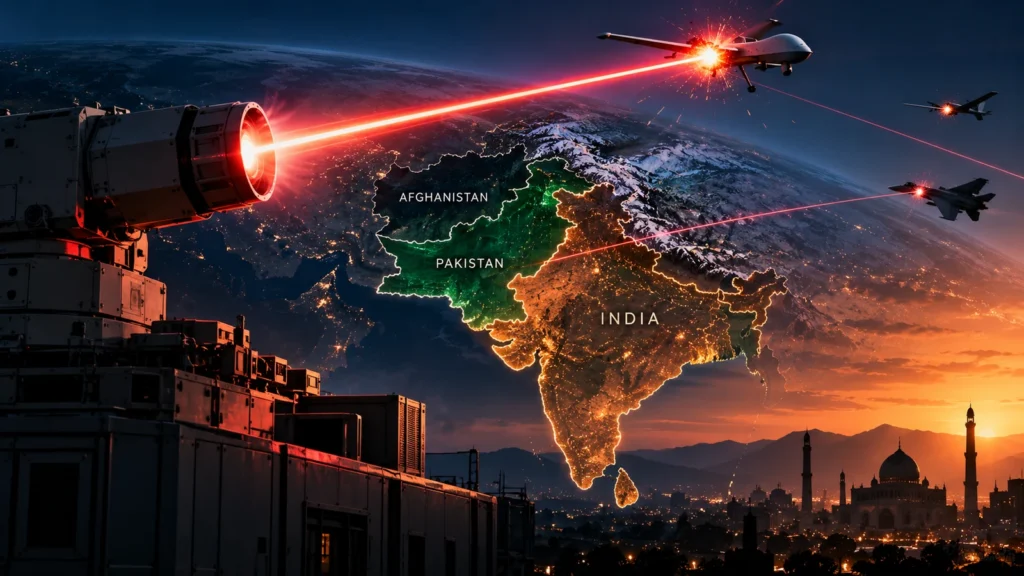
A conceptual illustration of directed-energy warfare in South Asia.
The battlefield calculus is being rewritten not by bigger missiles or faster jets, but by the modest cost of electricity. In conflicts ranging from Europe to the Middle East and Asia, a shocking fact has appeared i.e. $500 commercially available drones are being intercepted by $2 million interceptor missiles. This unsustainable asymmetry has forced militaries worldwide to seek alternatives. One of the possible solutions lies in Direct Energy Weapons (DEWs). Yet, while the global community debates the implications theoretically, South Asia finds itself on the frontlines of this technology. India, in particular, has emerged as the region’s clear first mover, and its trajectory is tpushing deterrence from strategic stability toward profound insecurity.
The year 2025-2026 will now be the first true year of operation of DEW technology and will represent the historic transition from prototype to platform which had previously limited DEW development. The tools need to be understood to appreciate the scale of the change. DEWs consist of many types. Among them, couple of those are discussed. First, there are lasers. Lasers are like a slow precision blowtorch. It takes a few seconds of “dwell time” to burn through a drone’s optical systems or airframe. The biggest benefit they offer is precision. They cause little collateral damage and can attack targets with surgical precision. But they are sensitive to their environment, i.e. dust, humidity and atmospheric turbulence impacting their performance.
Most importantly, they are single-target weapons, against competing with coordinated drone swarms. On the other hand, High-Power Microwaves (HPM) work like a “zap gun” and blasts out a broad beam of electromagnetic energy that destroys any drone in its way. This enables HPM systems to shoot several targets at once and is an advantage for swarm defence. They are, however, less mature than
the other, more difficult to aim with great accuracy, and present the serious danger of “fratricide,” melting friendly electronics around the beam’s path.
Both technologies have a number of common operating limitations: They need to be operated in pulsed mode, have complex cooling systems, and demand heavy prime power. They are ideal for point defence against small to medium drones beyond hundreds of meters to a few kilometres, not to replace missiles but as a layered addition to traditional air defence systems.
In the fragile nuclear environment of South Asia, India’s development has been devastating for the region. India has successfully tested its first high energy laser DEW “Sahastra Shakti” of 30 kW Mk-II(A) at Kurnool in April 2025. The system successfully destroyed fixed-wing UAVs and swarm drones, lead by India’s Defence Research and Development Organization (DRDO). India has made sudden progresses in its ambition since April 2025.
DRDO is said to be working on a 300-kilowatt directed-energy weapon that can neutralize threats in the range of up to 20 kilometers. This is supported by a roadmap for the “TEJASTRA” initiative, which sees the development of tactical counter-drone lasers of 10–20 kW, followed by 50–100 kW systems for cruise missile defence, and finally systems with power ratings of more than 100 kW for strategic applications.
New Delhi is not just working on lasers. It is actively progressing on microwave DEWs, such as the S-band system that has already neutralized quadcopter drones at one kilometer and has plans to increase its range to 5 kilometers. India has industrialized DEW program much faster than most of the “select club” of the states.
Conventional military strength is now dependent on new weapons of choice, such as cheap drones and loitering munitions. The May 2025 India-Pakistani drone and missile exchanges during Indian Operation Sindoor and Pakistani Operation Zarb e Azb, clearly revealed the reliance of both countries on the low-cost platforms. More importantly, the arrangement that DEWs can do is equal to turn the table during a conflict. If the laser or HPM system deals with a swarm of drones at
pennies per shot, the economic rationale of asymmetric warfare goes out the window.
With effective, low-cost per-shot point defence at border installations, cities, and critical infrastructure, India will offset drone threats. This may compel New Delhi to inadvertently go for escalation in the conflict. With such technology along with such risks, two nuclear-armed neighbors with a history of conflict, unresolved territorial disputes, and deep mutual mistrust than it is perilous for
the region.
What makes the situation even more perilous is that there are no regional laws and regulations regarding DEWs. Worldwide these systems are covered by the general provisions of the UN Convention on Certain Conventional Weapons and the Blinding Laser Protocol, but there is no specific regime for DEW. This disparity is greater in South Asia. There is no confidence-building or arms-control architecture for directed energy weapons.
In Conclusion, there is a vacuum of arms control and disarmament in the South Asia. Instead of addressing UN Sustainable Development Goals for its people like poverty, India’s spending on weapons always led to weaponization of the region resulting in instability, miscalculation and increased risk of escalation.
India’s DEW progress is combined with its 300kW roadmap and microwave development, which will upset the balance in the region, changing the basic economics and strategies of war. The time is rapidly slipping by for Pakistan to reset technologically, strategically, and diplomatically. Pakistan always calls and advocates for regional cooperation to set arms-control precedents for this new class of weapons and adjust its defence posture to meet the need of peace in South Asia.