Building Sustainable Nuclear Safety and Security Competence: The Evolution and Future Vision of Pakistan’s National Institute of Safety and Security (NISAS)
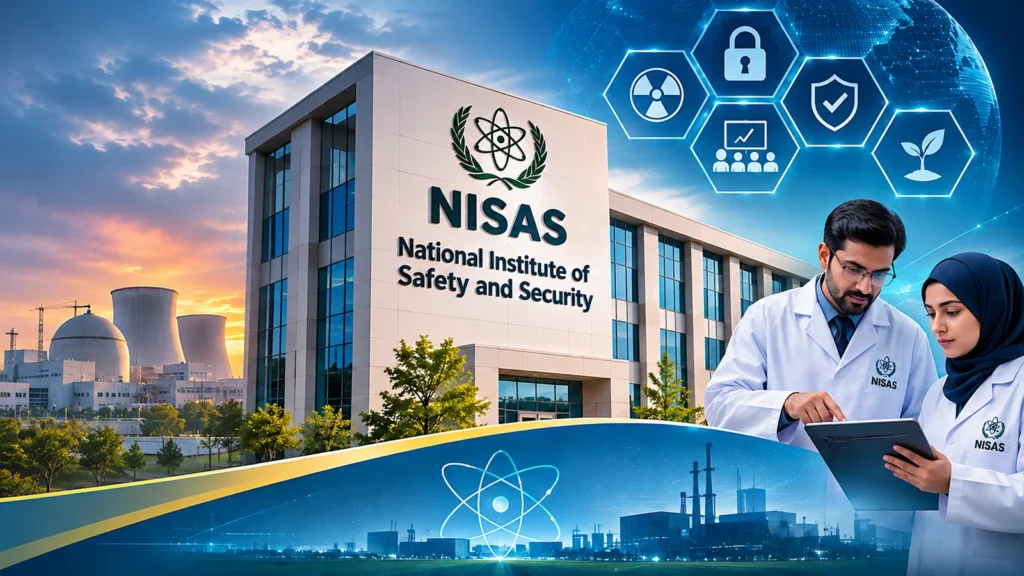
NISAS represents Pakistan’s efforts to develop national expertise in nuclear safety, security, professional training, and institutional capacity.
Nuclear safety and nuclear security are two sides of the same responsibility. Safety is about preventing accidents, while security is about preventing, detecting and responding to theft, sabotage and other malicious acts involving nuclear and radioactive material. Both depend on people: licensing officers who understand reactor systems, inspectors who can test a physical protection system, and first responders who know what to do when a radiation alarm sounds. Pakistan recognised this early, and the institution it built to develop such people within its regulator is the National Institute of Safety and Security (NISAS) of the Pakistan Nuclear Regulatory Authority (PNRA). Its story is one of steady investment in competence, and it now offers Pakistan a platform for contributing to nuclear safety and security well beyond its borders.
The roots of NISAS go back to 2006, when PNRA set up two training institutes through public-sector development projects: the School for Nuclear and Radiation Safety and the Nuclear Security Training Center, the latter created under the Nuclear Security Action Plan. In 2014 PNRA merged them into a single institution, NISAS, which was inaugurated by the then IAEA Director General, Yukiya Amano. The earlier security centre had already drawn praise in an independent 2012 study of nuclear security centres, which presented it as a model of what such a centre should do in training and advising a state’s competent authorities. Between 2011 and 2015, NISAS and its predecessors conducted 61 nuclear security training courses attended by more than 1,250 officials, and in 2015 alone trained 155 participants from national organisations. The consolidation of two institutes into one was a deliberate choice to give safety and security training a permanent institutional home inside the regulator.
The institute’s strength lies in its facilities and in the structure of its training. Its laboratories include a soft panel training simulator, physical models of nuclear power plant equipment, interior intrusion detection and access control labs, CCTV systems, and a radiation detection equipment laboratory capable of troubleshooting. Training is organised as a career pathway: new regulatory staff complete a basic course covering nuclear and radiation safety, regulatory control, physical protection and interpersonal skills, and after a year of work they attend a second-level course suited to their assigned area, such as PWR plant systems, radiation protection or physical protection of installations. NISAS is also ISO 9001:2015 certified. The IAEA’s 2014 Integrated Regulatory Review Service mission noted this system as a good practice, recognising a comprehensive national education system and a well-developed PNRA training programme that maintained staff competence during a period of rapid expansion.
International recognition came in October 2022, when the IAEA designated NISAS as a Collaborating Centre for nuclear security education, training and technical support. It was the tenth such centre in nuclear security worldwide, and the IAEA’s Deputy Director General said the designation would strengthen nuclear security education and training across Asia and the Pacific. The agreed work plan covers hosting IAEA courses and workshops in NISAS’s training centre and physical protection laboratories, hosting researchers and fellowships, supporting the development of guidance documents, and sharing experience through expert missions. By then NISAS had already hosted or organised more than 30 national, regional and international courses with the IAEA since its inauguration in 2014. Pakistan’s Foreign Office presents the designation as recognition of the country’s expertise in nuclear safety and security.
The record since then shows an institute operating at a high tempo. From 30 March to 24 April 2026, PNRA and the IAEA ran the Agency’s four-week flagship Basic Professional Training Course on the nuclear safety of nuclear power plants in Islamabad, with participants from 16 countries, and an IAEA expert noted the value of PNRA’s experience for countries embarking on nuclear programmes. In its September 2026 statement to the IAEA General Conference, Pakistan said NISAS-PNRA had trained 23 officials from 17 countries, including participants from Africa, the Middle East and Asia, in an intensive four-week course on IAEA safety guidance for regulatory infrastructure. In July, NISAS organised a five-day national course on computer security inspections led by experts from the IAEA, the Republic of Korea and Brazil, and in September it held a five-day workshop on workplace monitoring for 26 participants from national organisations. Safety, radiation protection and cybersecurity are all being taught in the same year, to home and foreign audiences.
NISAS also did the groundwork for Pakistan’s most significant review. In September 2024, it hosted a three-day national workshop on the International Physical Protection Advisory Service, led by an IAEA team with experts from Lithuania and the United Kingdom, for 26 participants from PAEC, the Strategic Plans Division, the Foreign Office and PNRA, to prepare for the mission planned for 2025–2026. That mission took place between 28 September and 9 October 2026, and the IAEA team concluded that Pakistan has a robust regime for the physical protection of nuclear material and facilities, noting that it is continually improved through periodic reviews and that the country’s capacity-building infrastructure contributes to expertise nationally, regionally and internationally. The IAEA’s Deputy Director General called Pakistan’s contribution to the nuclear security workforce commendable.
The value of NISAS to Pakistan is visible in the way its training reaches beyond the regulator. PNRA has a memorandum of understanding under which it trains Pakistan Customs, giving officers hands-on experience with radiation detection equipment and in responding to alarms, which has helped equip entry and exit points on the border. Seminars for scrap dealers and steel mill owners raise awareness of orphan radioactive sources, which reduces the chance that such material is accidentally melted, and awareness programmes have been run at educational institutions, industrial sites and medical centres across the country.
Tabletop and field exercises prepare response organisations, district administrations and law enforcement for their roles in a radiological emergency. The Pakistan Institute of Engineering and Applied Sciences adds a specialisation in nuclear security to its master’s programme in nuclear engineering, developed with IAEA curriculum guidance and drawing faculty from PNRA. Pakistan’s regulatory cooperation with Nigeria, where PNRA provides training and technical support, shows the same competence being shared with partners across the Global South, and a 2024 national workshop on communication during nuclear emergencies with the IAEA extended it to public engagement.
The next phase gives NISAS an opportunity to lead. The Collaborating Centre agreement runs until 2026 and is due for renewal, at the same time as the IAEA begins its 2026–2029 Nuclear Security Plan and as Pakistan has signed a Country Programme Framework with the Agency for 2026–2031. One Pakistani analysis argues that the renewed designation could carry a wider mandate covering drones and computer security, building on the computer security inspection course and the existing physical protection laboratories.
A joint programme on counter-drone and cyber threats would address risks that modern plants, with their digital control systems, increasingly face, and the same laboratories could serve newcomer states in Asia, Africa and the Middle East that need regulators and security managers trained from the start of their programmes. Pakistan’s request for PCENS to receive the same Collaborating Centre designation would complement this work by pairing NISAS’s regulatory training with PCENS’s operational and response training. Further steps could include more simulator-based and digital training, a complete master’s degree in nuclear security, and wider links with universities, ideas the training community inside Pakistan has itself put forward.
Pakistan’s experience with NISAS offers a clear lesson that sustainable safety and security come from people who are trained, retrained and trusted with responsibility. Starting from two small institutes in 2006, Pakistan built an ISO-certified institution inside its regulator, earned the IAEA’s designation as a Collaborating Centre, and now trains professionals from dozens of countries alongside its own. If NISAS keeps its curricula current with new technologies, renews and broadens its partnership with the IAEA, and opens its laboratories and classrooms to partners from the region and beyond, it can grow from a national training institute into one of the leading centres of nuclear safety and security competence in the world. The value of such an institution lies in the professionals and the culture of responsibility it produces, and Pakistan has shown that it is committed to both.