Energy, War and the Rule of Law: The 2026 Iran Crisis as Seen Through the Context of the International Law of Security, Peace and Sustainable Development
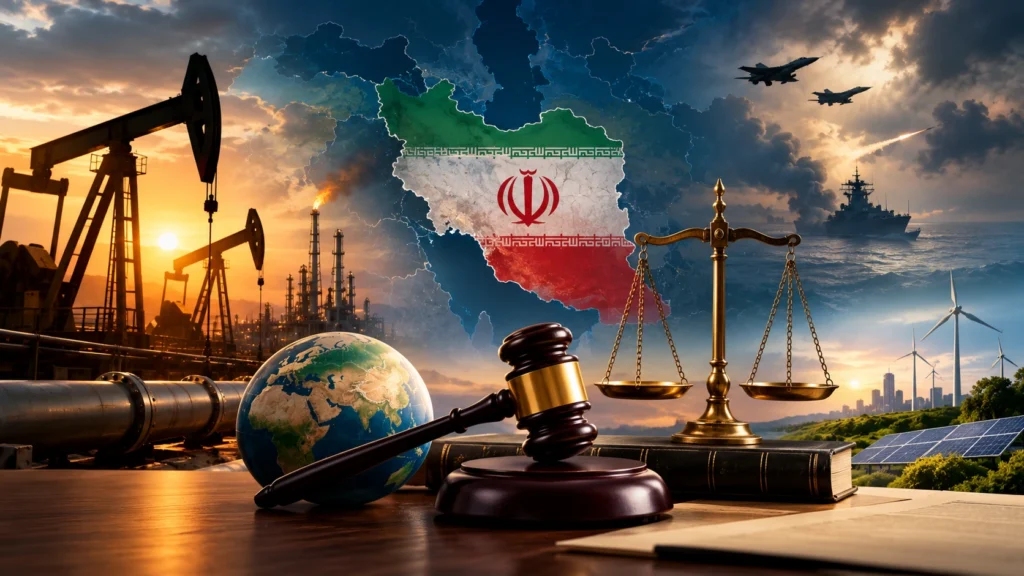
The 2026 Iran crisis highlights the complex intersection of energy security, armed conflict, international law, global peace, and sustainable development.
The 2026 war involving Iran, Israel, and the USA, represents not only a narrative of military attacks and energy diplomacy. What is at stake is also the idea of international law. The crisis within a few months brought up almost all the issues that the field of the International Law of Security, Peace, and Sustainable Development has to deal with. First, when is the use of force legitimate? Second, does a country have a legal right to block a strait, through which one-fifth of the entire oil production is being exported?
Moreover, is it legal to impose sanctions on the energy sector of another country? What effect has that on the stability and progress of sustainable development? The article discusses the energy crisis of 2026 from the legal perspective, considering the rules concerning the use of force (jus ad bellum), navigation in the Strait of Hormuz, as well as the international humanitarian law. The conclusion that can be drawn is that energy security cannot be separated from the rule of law. When it comes to the respect of international law concerning used of force, navigational issues, and civilian protection, peace is typically absent, as well as sustainable development.
International law is primarily based on the principle highlighted in Article 2(4) of the UN Charter: no country should attack another country. The only exceptions are enabling clauses from the Security Council and Article 51 on self-defence. Many experts, in international law, have called the strikes that killed Supreme Leader Ali Khamenei and attacked military and nuclear facilities an evident violation of Article 2(4) because there was no prior Security Council sanction or attack by Iran. Iran justified its closure of the Strait of Hormuz and its threats to tankers based primarily on its right to self-defence, and it is regarded as the victim of an illegal attack, which gives rise to legitimacy for any protective action taken afterwards.
On March 11, 226, the Security Council passed Resolution 2817, which condemned what it referred to as Iran’s ‘flagitious attacks’ on Bahrain, Kuwait, Oman, Qatar, Saudi Arabia, UAE, and Jordan; and demanded the cessation of Iranian action pertaining to Gulf shipping. Thirteen nations voted in favour, while China and Russia abstained from voting, claiming that the text ignored the previous unauthorized attacks conducted by the US and Israel. The Resolution used Article 51 self-defence wording in relation to the Gulf nations, while failing to demonstrate any opinion on the legitimacy of the attacks that had previously been conducted and which sparked the war.
The Strait of Hormuz occupies the core of the dispute, as in this vital shipping channel about 20% of world’s crude oil and one-third of the liquefied natural gas is transported. International straits like Hormuz, according to the UN Convention on the Law of the Sea (UNCLOS), are generally classified as channels of transit passage, a stricter regime compared to the right of innocent passage applicable to territorial waters. Neither Iran nor the USA has ratified UNCLOS although scholars argue that this regime of transit passage may be regarded as reflecting universally recognized international law.
However, Iran rejects this idea insisting that only the right of innocent passage applies in its case. In March 2026, Iranian parliament passed Hormuz Transit Fee Law introducing tariffs up to 2 million dollars for one trip. The U.S. naval blockade declared in April 2026 applied against Iranian ports only was portrayed as a more limited and legally justifiable action than closing the Strait as a whole; nevertheless, it also has an unstable legal ground because of the problem of whether there is an armed conflict taking place.
One more legal aspect concerns civilian objects protection in times of war. Early into the conflict, the US warned Iran of possible attacks on Iranian civilian energy installations, including Kharg Island, where most of Iran’s oil exports pass through, and its desalination plants. International humanitarian law does not allow for such threats. Water supply systems and other facilities where dangerous forces are present are shielded from any form of aggression. The conduct of both sides reveals a worrying problem: economic infrastructure vital to civilian survival is treated as a legitimate target in warfare, even though international law prohibits attacks on such facilities.
Ongoing Sanctions by USA against Iranian Oil and Financial Industry imposed by Executive Order Number 13902 raises the crucial legal dilemma in regard to the beginning of the applicability of sanctions as an absolute lawful sovereign measure and their crossing into the realm of compliance and even aggressive measures against another sovereign state. Unilateral sanctions of this nature especially secondary sanctions that restrict third parties like China from engaging in any business with Iran occupy the genuinely controversial area of international law in that there is no treaty convention regulating their legitimacy. Most unambiguous is their humanitarian impact: the sanctions preventing a country from selling oil and importing goods deny the population their right to energy, medical services and food resulting in issues of sustainable development.
The unheard aspect of this crisis is sustainability. The closing and disputed reopening of the Strait of Hormuz has caused an energy shortage across Asia in a matter of weeks, demonstrating the disturbing fact that a single military and legal conflict in one waterway may impact energy access of countries located thousands of miles away and do significant damage to the declared objectives of the Sustainable Development Goal number 7 – provision of energy at affordable prices for everyone.
These unresolved disputes brings into question Sustainable Development Goal 16, which seeks peaceful and secure societies and access to justice. For a genuinely sustainable energy order in the Gulf, it is necessary to achieve not only a truce but also a legal solution, which involves an agreement enabling, ideally through the adoption of UNCLOS or a dedicated regional treaty, to establish the rules of strait regulation in peacetime and during crises.
The events of 2026 point towards three distinct areas in which international law can take practical steps in this area. The first step would be the ratification of UNCLOS by Iran and the US, or at least the conclusion of a binding agreement regulating the transit passage through Hormuz. Secondly, if stricter multilateral norms concerning secondary sanctions against energy trade could be developed, states would be less likely to resort to the practice of energy coercion as an alternative to legal resolution of disputes. Finally, stronger enforcement of international humanitarian law concerning protection of energy supply and water resources infrastructure may play an important role in ensuring that oil terminals and desalination plants are identified as civilian (and not military) facilities.
The Iran-Middle East energy crisis of 2026 illustrates that the issues of energy, security, peace, and sustainable development cannot be considered separately. International law is the instrument that allows to solve this problem, using such tools as the provisions of the UN Charter on the use of force, the transit passage regime of the UNCLOS, and the norms of international humanitarian law on the protection of civilian facilities. The crisis of 2026 demonstrates that the same law is not missing; it is just not applied properly and systematically. In a field that deals with International Law of Security, Peace, and Sustainable Development, the key message from 2026 is that sustainable energy security in the Gulf, as well as sustainable development in general, can only be achieved when the rules are applied uniformly towards all parties involved rather than in a selective way by the strong against the weak.