Afghanistan Outlasted One World Order. Now It Tests the Next.
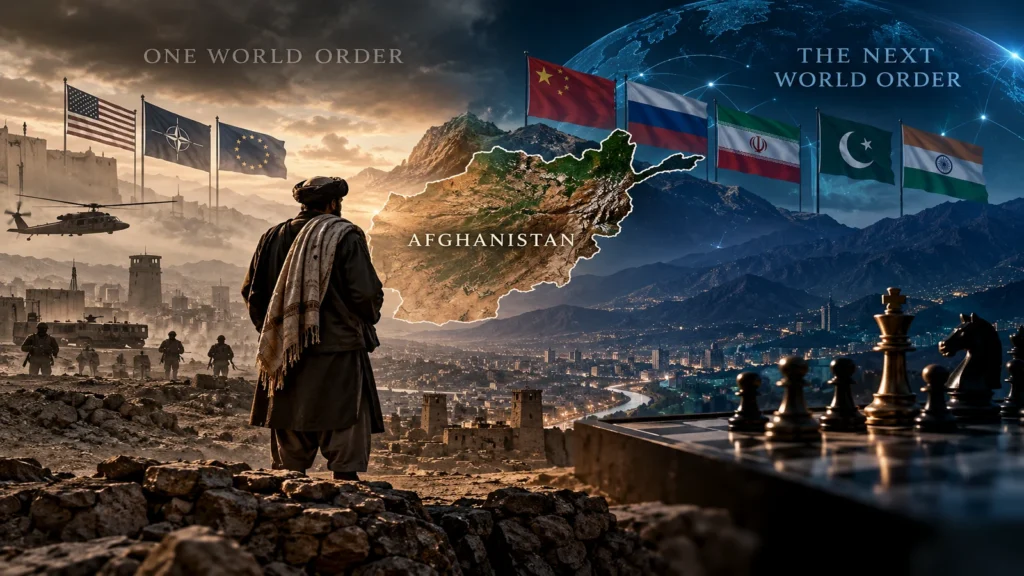
Afghanistan stands at the crossroads of a changing global order, as established powers give way to new geopolitical rivalries and strategic interests.
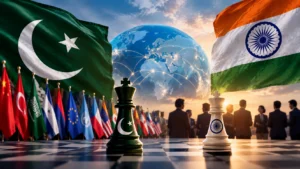
On Oct. 5, countries that can hardly agree on anything met down in Moscow to discuss a threat that concerns them all. India and Pakistan have been at a standstill after their military clash in May 2025. Iran is still at war with the United States. War rages between Russia and Ukraine, while China is engaged in a long-term power battle with Washington. Still, it was Afghanistan that had brought them together. It begs two questions: Why would adversaries who don’t agree on much else agree that this one country needs their attention? And can they even come up with a feasible solution?
Afghanistan survived the unipolar moment, and it is rapidly becoming the first test of a multipolar one. The United States had twenty years, an estimated $8 trillion, and the unparalleled might of a unipolar globe. The hegemon sought to rebuild Afghanistan from the inside, by force, on a scale that few interventions could match. But it left in August 2021 without success, after enormous human and economic casualties. Withdrawal didn’t fix the situation. It created a vacuum, soon filled by the very forces the world had fought to beat. The great nations turned away, and the matter was handed on to Afghanistan’s neighbours. While preoccupied with their own rivalries and disputes, they are now seeking to contain the terrorism originating from Afghan land, most visibly in the form of the Tehrik-i-Taliban Pakistan (TTP) and the Islamic State Khorasan Province (ISKP).
The region is trying engagement, not coercion. In 2016, the Moscow Format was created to build regional consensus on reconciliation and stability in Afghanistan. In November 2018, it brought together Taliban representatives and members of Afghanistan’s High Peace Council around the same table, however the Taliban refused to speak directly to the council. Counter-terrorism, especially ISKP, drug trafficking and regional economic integration were the prime concerns after the Taliban’s capture of Kabul. The Taliban formally attended the meeting as a member for the first time in October 2025. The eighth round was held on October 5 2026 and was attended by Russia, Pakistan, India, Iran, China and the Central Asian states, with the Taliban delegation headed by Foreign Minister Amir Khan Muttaqi. But Moscow isn’t the only course. China’s hosting of negotiations, the mediation by Qatar, Turkey and Saudi Arabia and Russia’s formal recognition of the Taliban government in July 2025 are all attempts to solve the same problem by various means.
Afghanistan has become a flashpoint for the entire region. Since the Taliban’s takeover, the TTP has become more coordinated and better positioned to launch cross-border strikes against Pakistan, supported by the kin-jihad nexus it shares with Afghanistan’s leadership. The toll is visible in attacks such as the attack on the Kohat police headquarters in September that killed 31 people. The recent UN Monitoring Team assessment stated that the Taliban “continued their support” to the TTP. ISKP, which the same assessment describes as “the greatest threat to the Taliban authorities and the region”, has struck well beyond Afghanistan’s boundaries. It was related to the March 2024 attack on Moscow’s Crocus City Hall that killed at least 139 people and the Islamic State twin explosions in Kerman, Iran, that killed 94 two months earlier. China has its own concern: UN monitors say there is an increasing presence of Uyghur extremists in Badakhshan, the region that borders China. Iran, however, is coping with the spillover of refugees and border tensions, sending back more than 1.1 million Afghans across the border alone in the year up to July 2025. Kabul has always denied that its soil is being used for terrorism, but the escalating bloodshed in Pakistan and the worries stated repeatedly by these states point in the other direction; a common dread has brought them to the same table. But that was never the goal.
Multipolarity provides more avenues of action, but no force can bring Kabul to heel. Forums issue joint statements, but pronouncements do not bring verification or enforcement. The Express Tribune said that the Moscow Format concluded without a unified declaration for the first time since its inception as the Taliban delegation objected to language tying Afghanistan to terrorism. Russia’s envoy Zamir Kabulov conceded “it can work and continue to exist without” one. The question is not whether multipolarity is better than unipolarity or vice versa. The outcome is still unknown. The multipolar world order will be judged by whether its forums can transform shared fear into shared rules, something the US-led system failed to do in Afghanistan despite having every resource and every kind of force at its disposal.
The fundamental question is, how long will answers be sought without holding the major stakeholder accountable? The Taliban are now at the table. The forums that host them must make sure that what is discussed there has consequences. Kabul must conform and accept the truth of its predicament. The cost of sponsoring terrorism must rise collectively and persistently or the Taliban have nothing to lose. History has shown that neither the Soviet Union, nor the United States, nor now a regional collective will succeed unless the stakes are elevated to a level where Kabul cannot afford the damage it is doing to the region and to its own people.