How has Pakistan Countered India’s Diplomatic Isolation Strategy?
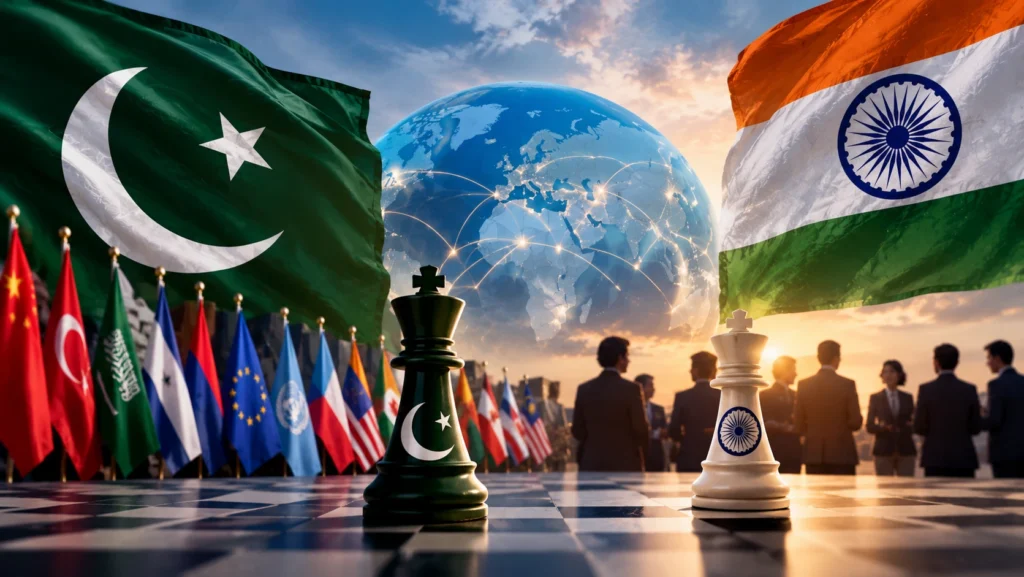
Pakistan and India compete for international influence as global alliances, diplomatic engagement, and strategic partnerships shape South Asia’s geopolitical landscape.
For the last decade, India has been officially putting efforts into isolating Pakistan diplomatically in the global political arena. Indian Prime Minister Narender Modi, speaking at a public rally in 2016 in Kerala, promised he would isolate Pakistan diplomatically. In the years to come, India engaged its diplomatic machinery and established a strong case in Western capitals that Pakistan sponsors terrorism in India. As a result, Islamabad faced international scrutiny and was cornered diplomatically at international forums. Additionally, foreign investments were reduced, and travel warnings were issued, compelling Pakistan to make hard choices.
However, today Pakistan stands at the epicenter of global diplomacy in just one decade. Now, Islamabad has stronger ties with Western capitals, is considered a credible security provider in Gulf capitals and is regarded as a reliable negotiator globally. The following article explores how Pakistan’s actions foiled India’s decade-long efforts to diplomatically isolate it.
New Delhi operationalized its isolation strategy against Islamabad at three levels. At the international level, it presented a false narrative that Pakistan is the epicenter of cross-border militancy through its diplomatic missions. Moreover, it also exploited its huge economic reserves to influence major media houses and think tanks with global reach that framed Pakistan as an exporter of terrorism. Second, at the multilateral level, India used international forums like the United Nations (UN) to publicly derail Pakistan’s image with fabricated facts aimed at proving that Pakistan is a safe haven for different terrorist groups. Indian authorities also leveraged their influence in multilateral institutions via their diaspora to increase diplomatic pressure on Pakistan, which compelled Islamabad to make choices that it would not have in normal circumstances.
At the regional level, India pursued a broader strategy for Pakistan’s diplomatic isolation. It not only suspended its bilateral relations with Pakistan but also compelled other regional countries under its influence not to continue healthy working relations with Islamabad. For instance, following the Uri attack, it withdrew from the South Asian Association for Regional Cooperation (SAARC) summit and influenced other regional capitals to do so.
Resultantly, for some years Indian efforts seemed to be successful. Pakistan was diplomatically cornered by the major states. President Trump, during his first tenure, regarded Pakistan as an untrustworthy nation. Later on, President Biden had limited interactions with Pakistan as Islamabad, for the time being, was not in America’s good books. Pakistan was, for the third time, again put on the Financial Action Task Force (FATF) grey list in June 2018. Major regional states, including Bangladesh, Nepal and Iran, limit their economic and political interactions with Pakistan due to their economic interdependence with India. Islamabad also faced travel warnings from several major capitals and was labelled as not a secure country for their nationals. Internally, it was fighting the worst kind of terrorism sponsored by India.
However, the May 2025 India-Pakistan crisis turned the tables for Islamabad. The major Western capitals were already fed up with India’s fake framing of Pakistan as a terrorism-sponsoring state. The false-flag Pahalgam operation further uncovered the fragility of the Indian narrative as New Delhi failed to convince others regarding Pakistan’s role. Ironically, this false-flag operation was similar to those of the 2008 Mumbai terrorist attack, the 2016 Uri terrorist attack and the 2019 Pulwama terrorist attack. Based on a false narrative that Pakistan is behind the Pahalgam terrorist attack, India attacked Pakistan’s mainland under the guise of Operation Sindoor. However, this time, Western political leaders and media were not convinced by the Indian narrative that Pakistan is behind the terrorist attack in Pahalgam. Instead, major Western capitals were exasperated with India’s baseless allegations against Pakistan and they insisted that South Asian rivals practice restraint to avoid escalation.
After four days of intense fighting, the nuclear-armed adversaries halted offensive campaigns against each other with United States (US) President Donald Trump’s intervention. Pakistan publicly praised the American role under President Trump in the ceasefire, While India avoided doing so. India has a stance that any issue with Pakistan is a bilateral matter and that it will resolve it bilaterally. However, during the ceasefire talks, President Trump developed a good working chemistry with Pakistan’s Chief of Defence Forces (CDF), Field Marshal Asim Munir. This led to a breakfast meeting between President Trump and Pakistan’s CDF in the Oval Office. During the meeting, along with Iran’s issue, several topics came under discussion. President Trump was inspired by CDF’s deep insights regarding Iran. CDF had previously headed both prime intelligence agencies of Pakistan, Inter-Services Intelligence (ISI) and Military Intelligence (MI), which enabled him to impress President Trump with his knowledge.
Eventually, when the US-Iran crisis erupted, Pakistan offered to play a mediatory role. The breakfast discussion compelled Washington to recognize Pakistan as a credible intermediary between the US and Iran. Islamabad also remained cautious regarding allowing its territory, airspace or military infrastructure to any party to the crisis. This policy reassured Iran of Pakistan’s neutrality and its credibility as an unbiased negotiator. During negotiations, Islamabad coordinated closely with China, Saudi Arabia, the United Arab Emirates and Türkiye, positioning itself as a responsible regional actor. Whereas India, which has long maintained a strategic partnership with the US and close economic relations with Iran, failed to establish its credibility in both capitals as a responsible negotiator.
Pakistan’s role during the US-Iran negotiations marked an important diplomatic comeback after years of India’s effort to isolate Pakistan. As Washington, Beijing, Tehran, Riyadh, Ankara, Cairo and other capitals maintained active diplomatic engagements with Islamabad during the negotiations, it demonstrates that Islamabad continues to occupy an indispensable geopolitical position. It is not viewed through the lens of terrorism; it is viewed as a state capable of facilitating dialogue with credibility and neutrality. Today, Pakistan enjoys a strategic partnership with China and continuously growing healthy relations with America. It has close political and religious ties with almost all Gulf countries.
Moreover, European countries have regarded Islamabad for its diplomatic efforts in the US-Iran conflict. After the first US-Iran ceasefire, Saudi Arabia has signed a Strategic Mutual Defence Agreement with Pakistan aimed at treating an attack on one as an attack on both. It is reported that under the agreement, Pakistan has deployed its land forces along with a small portion of the Air Force in Saudi Arabia. Recently, Pakistan, Saudi Arabia and Turkey have also signed a joint defence agreement in the holy city of Makkah.
It is believed that this agreement is based on Article 5 of NATO, where an armed attack on one would be regarded as an armed attack on all three. Thus, India’s diplomatic strategy to portray Pakistan as a source of instability and to persuade major powers to limit engagements with Pakistan has been overshadowed by Pakistan’s effective counter-diplomatic campaigns. Today, Pakistan enjoys a position as a rising middle power that no other country enjoys today. Pakistan should capitalize on this diplomatic momentum and land its narrative in the Western capitals. It’s now Pakistan’s turn to comprehensively engage its diplomatic machinery and provide evidence in all major capitals of Indian sponsorship of terrorism in Pakistan.