Institutionalizing Pakistan’s Defense Export Pipeline
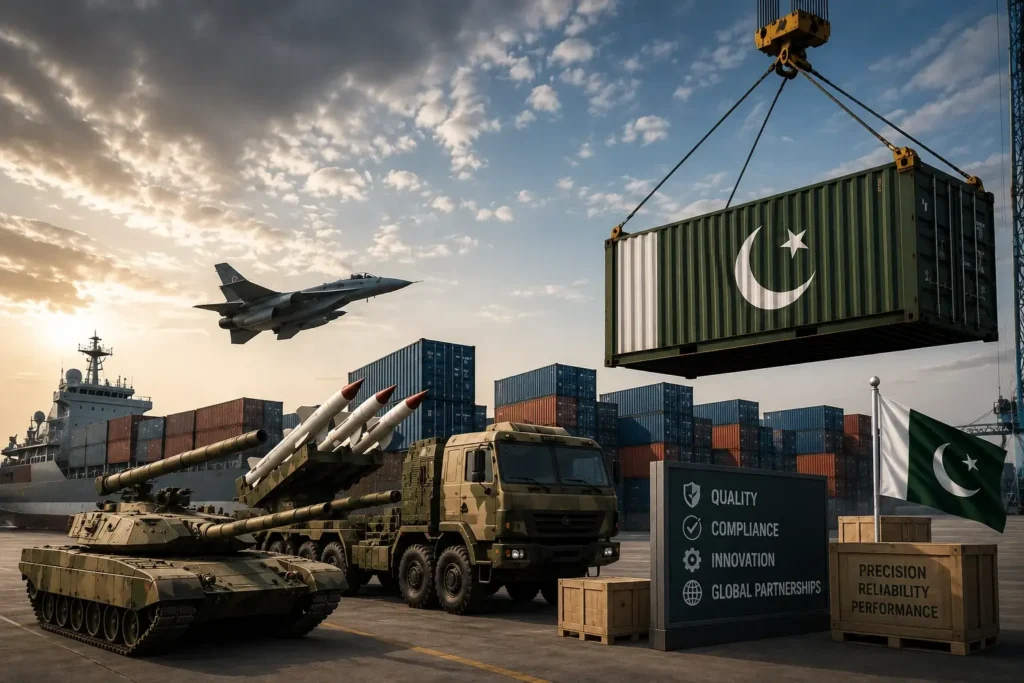
A conceptual illustration of Pakistan's defense manufacturing, logistics, and export ecosystem, highlighting the institutional framework required to strengthen the country's global defense export capabilities.
The defense sector in Pakistan has been a hidden economy for long and lately the country has seen a spate of export contracts which seem to be a conscious shift towards strategic economic statecraft. State-owned giants like Pakistan Aeronautical Complex Kamra (PAC), Heavy Industries Taxila (HIT), Pakistan Ordnance Factories Wah (POF), and Karachi Shipyard and Engineering Works (KSEW) are dominating this production landscape, providing platforms now in demand worldwide. The change is demonstrated by two recent deals: a deal for roughly $4 billion worth of JF-17 fighters and Super Mushak trainers to the eastern command of Libya, and an estimated $1.5 billion package with Sudan for Karakoram-8 aircraft and loitering munitions. But this movement could be short-lived without institutional support.
The defense-export system is now based on the Defense Export Promotion Organization (DEPO) that manages communication and coordination regarding the export of defense products and services through the Ministry of Defense Production (MODP), along with state-owned defense manufacturers like PAC and HIT. However, this architecture was intended for trade-show marketing rather than institutional arms-export bodies like Defense Acquisition Program Administration (DAPA) of South Korea or Secretariat of Defense Industries (SSB) of Turkey, which include centralized licensing procedures, export financing, offset arrangements, and government-to-government contract structuring. This promotion-based system becomes a structural burden to Pakistan’s tracked order book as it continues to grow towards $13 billion unless changed into a single export authority.
The new budget for Fiscal Year 2026-27 has allocated 3 trillion rupees for defense, an increase of 17.65%from the initial allocation of the previous year, while the defense physical assets allocation has increased by nearly 18 percent, which is the highest defense procurement acceleration since FY2019-20. This is an important domestic scale-up for an export pipeline: larger production runs mean lower unit costs and provide idle capacity to redirect to export orders when domestic orders are fulfilled..
The government of Pakistan, in June 2023, created a Special Investment Facilitation Council (SIFC) as a single window catalyst for facilitating investors and fast-track project development. It consists of apex committee as its highest decision making body chaired by the prime minister, followed by cabinet and executive committees for policy and administration respectively. SIFC has become the de facto coordinating body for defense sector investment through the Defense Export Promotion Organization and IDEAS Defense Expos. The apex committee avoids the multilayered bureaucratic clearances which have taken a long time in the past to approve export licenses and close the deals. But this is not institutionalization: SIFC has no statutory export-governance mandates, instead it is based on political will and convening power. The facilitation role should be established in a permanent legal framework so that the pipeline lasts beyond the life of the current government.
With coordination from SIFC, Pakistan’s export facilitation model was able to secure a $4.6 billion deal for 40 aircraft with Azerbaijan, an existing JF-17 operator. This is Pakistan’s largest defense export deal to date. Separately, after the bilateral defense deal established last year, Pakistan and Saudi Arabia are negotiating the conversion of approximately $2 billion in Saudi loans into a JF-17 fighter jet contract, with a total package worth $4 billion. This is effectively a debt-for-hardware exchange. Together, these instances demonstrate how institutional machinery converts latent demand into bankable transactions, but they also show that financing remains a legally binding obstacle to more export growth.
International Defense Exhibition and Seminar (IDEAS) 2024 attracted more than 555 defense exhibitors, of which 334 were international, with 82 MoUs signed, but very few of these converted into hard contracts. This gap can be filled by extending DEPO’s scope of work to include licensing authority, financing coordination and post-MoU deal management. Of course, DEPO and IDEAS are not producers, but hardware comes from other MoDP-owned enterprises.
In the overall history of IDEAS, that is held biennially, PAC’s JF-17 Thunder Block III has been the highlight, with confirmed orders coming from Azerbaijan, Nigeria and Myanmar, and ongoing negotiations with Saudi Arabia, Sudan, Indonesia and Bangladesh, as well as some interest from Iran, Sri Lanka, Zimbabwe, Algeria, Ethiopia, Argentina and Uzbekistan with the majority of interest coming from the Gulf, Sub-Saharan and North African markets, and a growing pull from Central Asia and Latin America. The Al-Khalid-I tank, which has been developed over the years by the indigenous industry, could finally find its way to export orders, especially from African and Gulf countries that are looking to replace their Western-made MBTs with alternatives that are durable, hardened and cost-effective.
Furthermore, Pakistan Ordnance Factories (POF), which is a manufacturer of ammunition and small arms and the National Radio and Telecommunication Corporation (NRTC) which manufactures communications and electronic warfare systems, are still underrepresented in exports despite the growing demand in the international market.
KSEW’s naval business of submarine and offshore patrol vessels constructed using international technology transfer puts it in a strong position to go after navies in the Gulf and Africa that are looking for inexpensive platforms in the face of a contested Red Sea and Gulf of Aden shipping lane. Pakistan Ordnance Factories’ ammunition and small-arms businesses, along with National Radio Telecommunication Corporation’s electronic-warfare systems, serve a consistent demand from government-to-government programs in the jet, tank, drone, naval and ammunition sectors in war-torn African and Middle Eastern markets. By contrast, Europe was largely represented in the form of exhibitor base, with 17 new countries participating in IDEAS-2024, including Italy and the United Kingdom, indicating that export gravity is still very much based in the Gulf and Africa.
The “triple helix” model, led by the Pakistan Air Force’s National Aerospace Science & Technology Park (NASTP), is an example of how public-private R&D can help change Pakistan’s trajectory from an assembly hub to becoming a design-led country. Two integrated examples: Baykar of Turkey has signed a cooperation agreement with NASTP for joint R&D of loitering munitions and advanced defense systems, while the first cohort of NASTP’s National Incubation Center for Aerospace Technologies (NICAT) incubator has produced 27 startups with 186 million rupees of revenue and about 250 jobs created. Nevertheless, the private sector has not yet achieved prime contractor status and is still limited in its capacity to carry out subcontracted machining which is an institutional barrier Pakistan must overcome in order to transform R&D into systems that can be exported.
Export-credit systems frequently determine which companies will get a defense contract. Turkey’s EximBank provides buyer nations with low-interest loans to acquire Turkish military gear, making them more affordable for cash-strapped militaries. In the same way, China Development Bank (CDB) makes long-term loans to African and Asian governments with low interest rates, usually contingent on the purchase of Chinese-made hardware. Both work because the fiscal space of the exporting state is available for lending. The IMF program of Pakistan leaves it with limited reserves to provide such credit lines. A more realistic solution is the one that is now becoming a reality: the debt that Pakistan owes to friendly states, or loans that can be obtained from those states, is being converted into arms buying.
There is no doubt that Pakistan is making progress in the field of defense exports, but an institutionalized system is yet to be built around it. The work of SIFC’s facilitation, NASTP’s incubators, and DEPO’s exhibitions has created opportunities which decades of import substitution could not have: each is an ad hoc fix, not a pipeline. Then there’s a test that will make it either add up or go down: quality assurance. While flexible standards are accepted in the Gulf and Africa, Pakistan’s SOEs have only seldom attempted to obtain the AQAP-certified production lines that NATO and Western purchasers are asking for.
Institutionalization is not just bureaucratic housekeeping; it is the primary distinction between a defense sector that exports occasionally to anybody who wants to buy something and one that can compete on quality, finance and design and has a chance of success for years to come, which, in the end, is the difference between a windfall and an industry.