From Crocus Hall to Waziristan: Why Russia and Pakistan are Comparing Notes
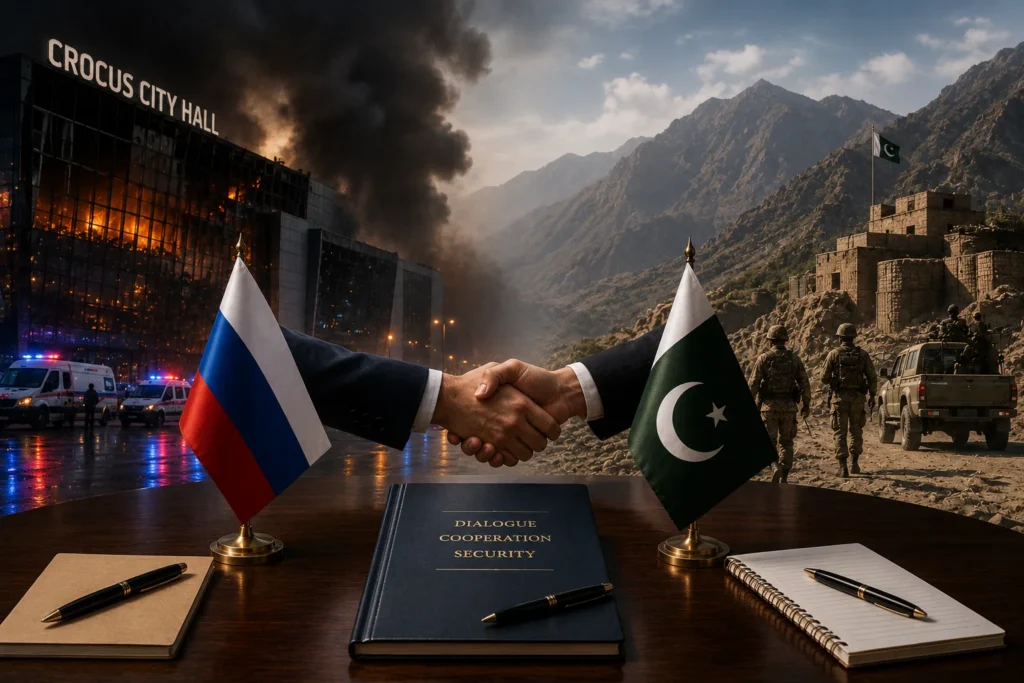
A conceptual illustration depicting the convergence of Russian and Pakistani security interests following major terrorist attacks, emphasizing dialogue, intelligence sharing, and strategic cooperation.
On June 23, 2026, Russian and Pakistani officials met in Islamabad for the 12th round of the Joint Working Group to Counter International Terrorism. Delegations led by Russian Deputy Foreign Minister Dmitry Lyubinsky and Pakistani Additional Foreign Secretary Khalid Jamali reviewed a familiar agenda: terrorism emanating from Afghanistan, extremist use of digital platforms for financing, recruitment and propaganda and intelligence sharing. This is real cooperation, not just diplomatic theatre. Moscow and Islamabad read the terrorist threat the same way. What they cannot agree on is Afghanistan, the country from which most of that terrorism originates.
The working group itself is not new. The 12th round follows an 11th in Moscow in April 2025 and a 10th on Pakistan’s foreign ministry before that. This is a standing bureaucratic channel, not a one-off gesture, and its consistent agenda suggests both sides treat it as working infrastructure rather than just diplomatic theatre.
The convergence behind it is genuine. On March 22, 2024, gunmen affiliated with the Islamic State Khorasan Province (ISKP) killed roughly 149 people at the Crocus City Hall in Krasnogorsk, Russia’s worst terrorist attack in two decades. Pakistan’s own toll has seen a similar trajectory: security forces recorded 3413 combat deaths in 2025, a 74% jump, making it the deadliest year for Pakistani forces since 2011. Both states are current targets of the same transnational network operating largely out of Afghan territory. That shared exposure gives the working group real substance.
An economic and defense layer sits alongside the security one, though it is thinner than often advertised. Bilateral trade roughly doubled to about $1.8 billion in the year to June 2024, driven mainly by discounted Russian crude, but flows have been uneven since and one recent stretch showed trade collapsing to a fraction of the prior year’s level. Defense ties are modest: four Mi-35m attack helicopters delivered in 2017 and formally inducted in 2018, after Russia lifted its arms embargo on Pakistan in 2014, with little beyond small arms since. Moscow’s investment in India caps how far this can go.
The center of this story is Afghanistan and here Pakistan and Russia are pulling apart. In July 2025, Russia became the first state to recognize the Taliban government, a decision driven largely by the wish to secure Kabul’s cooperation against ISKP. Pakistan’s relationship with the same Talian Government has collapsed. Border clashes in October 2025 were the deadliest in years, a Qatar-mediated ceasefire held on briefly, talks in Istanbul broke down in November, and open hostilities have continued since late February 2026, after Pakistani strikes on TTP and ISKP camps. Afghan drone incursions into Pakistani territory occurred as recently as July 1, 2026.
The strategic logic on each side explains the split. Russia is betting that engagement with the Taliban buys it a partner against ISKP and a foothold in a region where its leverage is otherwise thin. Pakistan has concluded that the government it once backed either cannot or will not restrain the militants operating from its soil, and has shifted to strikes and border closures instead, both states face the same enemy with opposite theories of how to defeat it, and neither theory is obviously wrong.
This split sets the real ceiling on what the working group can achieve. Technical cooperation, tracking ISKP financing, monitoring its propaganda, exchanging intelligence, can proceed regardless of politics, and probably will. A genuine regional counter terrorism architecture, with coordinated operations and unified pressure on Kabul, cannot, so long as Russia works through the Taliban and Pakistan works against it.
Pakistan does have something to offer beyond the Afghanistan question. The Saboon deradicalization program in Swat, running since 2009, and two decades to counter-IED, urban clearance and border-management experience amount to real expertise, not just diplomatic positioning, and it is expertise Russia largely lacks. For Moscow, access to that know-how is plausibly worth more than the erratic oil-driven trade figures or the frozen defense relationship. The honest description of where things stand is narrower than a full ‘regional counterterrorism architecture.” Russia and Pakistan are sustaining a technical, working-level exchange that survives despite a widening rift over Afghanistan, not because that rift has resolved.
That narrower ambition is not a defeat. A channel that keeps information flowing on ISKP’s financing and propaganda, even while Moscow and Islamabad disagree sharply on Kabul, is a real gain for both countries’ security. Counterterrorism cooperation does not Afghanistan settled to work in both countries’ favor. If Moscow and Islamabad resist overselling that relationship as more than it is, this modest, technical partnership stands a genuine chance of outlasting the dispute that divides them, precisely because it never depended on resolving it.
All opinions expressed are those of the author and do not reflect the views or policies of the organisation.