Qatar’s Rational Irrationality: Why a Bombed Mediator Stayed at the Table
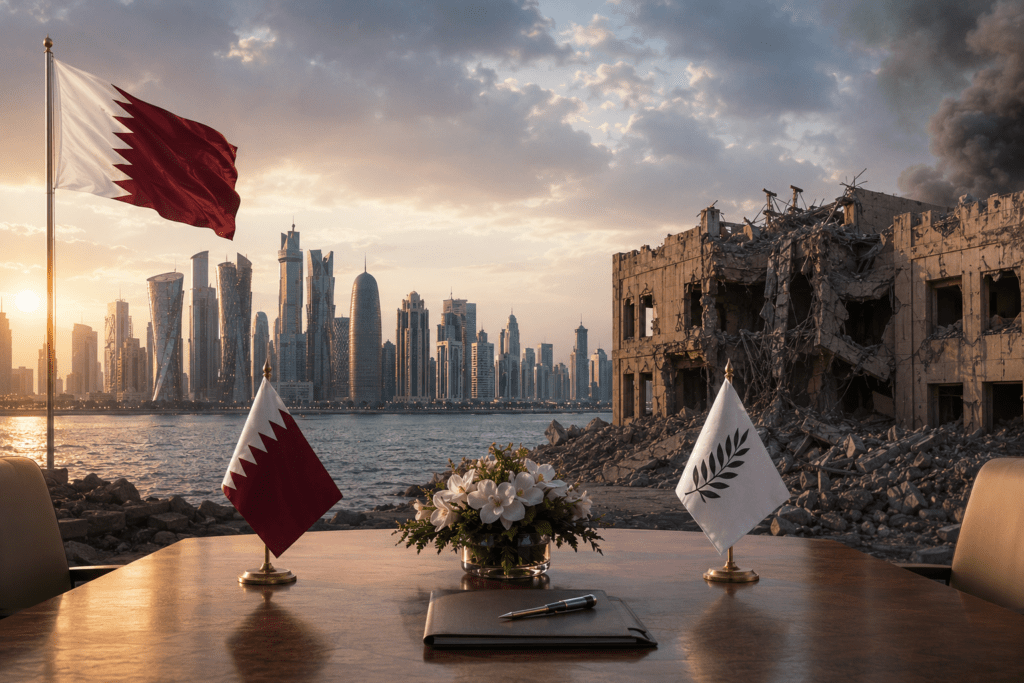
A symbolic depiction of Qatar's continued diplomatic engagement despite regional instability, contrasting Doha's modern skyline with the devastation of armed conflict.
In March 2026, Iran launched 5 missiles at Qatar. Four missiles were intercepted and one got through that struck Qatar’s Ras Laffan Industrial City – the engine of Qatar’s economy and the source of nearly a fifth of the world’s LNG supply – wiping out 17% of Qatar’s LNG capacity overnight, sidelined 12.8 million tons of production for up to 5 years, and wiped out 20 billion dollars in annual revenue. JPMorgan’s analysts issued a forecast: Qatar’s GDP could contract by 9% in 2026 alone. Global gas prices rose nearly fifty percent.
Qatar declared force majeure on contracts with Italy, Belgium, South Korea, and China. The rational response was that Qatar would step back, count its losses, and let someone else take the task of mediating between Washington and Tehran. Instead, Qatar sent its diplomats back to Tehran three times. On June 14, Qatari mediator Ali Al-Thawadi spent seventeen hours inside Iran, stranded at one point when US launched fresh strikes mid-negotiation, coordinating with Trump’s envoys Steve Witkoff and Jared Kushner on phone, before extracting the framework that became the Islamabad MoU. The deal was signed on 19th of June in Burgenstock, Switzerland. The world called it a peace deal. Qatar called it a Tuesday.
By every measure of classical realism, Qatar is a weak state – small in size, a native population of barely three hundred thousand, a military built for just symbolic deterrence. Georgetown’s Security Studies Review frames the problem plainly: “Nearby Iran and Saudi Arabia dwarf Qatar in material power…without self-sufficient and relatively dominant material power, small states are constrained by the behaviors of and relations between larger states.” Qatar has spent three decades building an answer to that constraint. Rather than choosing sides Doha deliberately cultivated a position in the gap between all of them and make itself useful to everyone at once. Scholars call this “strategic hedging”.
It hosts the US Central Command at Al Udeid Air Base while keeping open lines with Iran, Hamas, the Taliban, and Hezbollah. As The Diplomatic Insight frames it, this is “not a contradiction; it is strategic insurance.” That insurance policy has one requirement: Qatar must remain trusted by everyone even by its enemies. The moment it picks any side, it becomes just another aligned state and the moment it becomes just another aligned state, it loses the only comparative advantage it possesses. That logic drew real criticism. The UAE, which suffered the heaviest Iranian strikes of any Arab state, was blunt and its Washington ambassador said “a simple ceasefire isn’t enough.” He demanded reparations and a dismantling of Iran’s proxy network.
A media campaign accused Qatar of coordinating LNG decisions with Iran, acting as Tehran’s economic front. Qatar dismissed these as “fabricated and unreliable materials originating from parties seeking to sabotage mediation efforts.” Iranian hardliner Foad Izadi argued the opposite and said Washington had not paid enough to be trusted, and the deal would simply delay the next confrontation.
The reason is straightforward: Qatar’s ties to Iran are precisely what gave it credibility in Tehran when no one else did. Iran would not talk to Abu Dhabi and had no reason to trust Washington after the February strikes. But Qatar had built ties with Tehran across two decades of crises like the 2017 Gulf blockade, the Hamas hostage talks, the Taliban negotiations.
That was the sole channel that remained open when the war began. Springer Nature’s Discover Global Society frames the logic: “Qatar’s mediation must be situated at the intersection of three strategic logics: small-state survival in a volatile geopolitical environment, state branding through symbolic and performative diplomacy, and hedging across rival power axes.” Tandfonline’s Asian Journal of Middle Eastern and Islamic Studies adds the harder truth: small-state mediators “strengthen bilateral relationships with bigger states that are fundamental to meeting the existential demands of state survival.” Qatar was not being helpful rather it was protecting its own true asset.
Pakistan’s role was real but different. Pakistan’s tie with US gave Islamabad a direct line to the White House when formal channels were frozen. Pakistan delivered the US framework to Tehran but its leverage ran one way. A Western diplomat told The New Arab: “The Pakistanis were the face of the process, thanks to the field marshal’s relationship with Trump, but the Qataris quietly did most of the heavy lifting to bridge the two sides.” When talks collapsed in late May and Trump was considering further strikes then Qatar alongside Saudi Arabia and the UAE, requested Trump to hold back. He postponed the strikes and negotiations resumed.
The broader lesson is specific. Coercion worked but it creates pressure rather than building trust. The US bombed Iran while demanding good-faith talks. Israel attacked Iranian sites while claiming Lebanon was off the agenda. In such situation, the only actor both sides would respond to was the one who had never threatened either of them. Middle East Eye stated: “For a small state, diplomacy is not the strategy of the helpless; it is the rational choice of an actor that knows precisely what it can and cannot change.”
The MoU is just a framework for negotiation, not a resolution. Since the 2025 Israeli strikes, the IAEA has been unable to verify Iran’s nuclear programme and the deal’s core demands remain maximalist positions that Tehran has refused as final terms. The maximalist positions include complete dismantlement of Iran’s nuclear infrastructure, removal of all enriched uranium stockpiles, zero enrichment. The Lebanon front is the most immediate threat and Israeli Defence minister Katz has declared the IDF “will not withdraw from the security zone in Lebanon,” while the MoU explicitly demands the termination of military operations on all fronts.
As CSIS put it, “The Lebanon front holds the greatest potential to derail the deal.” The Doha meetings are not celebratory, they are the beginning of a genuinely hard 60 days negotiation, with the second and binding agreement that would actually govern Iran’s nuclear programme still entirely unwritten. However, Qatar’s mediation produced a pause. Whether it produces a settlement depends on variables like Israeli behavior in Lebanon, Trump’s political calendar and Iran’s domestic factional politics, over which Doha has limited or no control. Qatar exercised what it controlled.
Qatar will not claim the credit. Prime Minister Sheikh Mohammed bin Abdulrahman Al Thani expressed hope that all parties would engage in future negotiations “in a positive and constructive spirit” and said nothing about Qatar’s own role. That restraint is strategic: a mediator that claims victory burns the goodwill needed for the next crisis. The $20 billion in lost LNG revenue is real. So is the deal signed in Switzerland.
Qatar accepted the financial loss to make that deal possible not out of goodwill, but because a small state that loses its reputation as a reliable mediator has almost nothing left. For any state caught between powers it cannot fight or fully satisfy, the lesson is simple: build the channel before the fire starts, hold it when the costs rise, never walk away. That is not irrationality. That is the only rational strategy available to a state that has no better alternative.