The China-Pakistan-Bangladesh Triangle: A Counterweight to India’s Aspirational Dominance
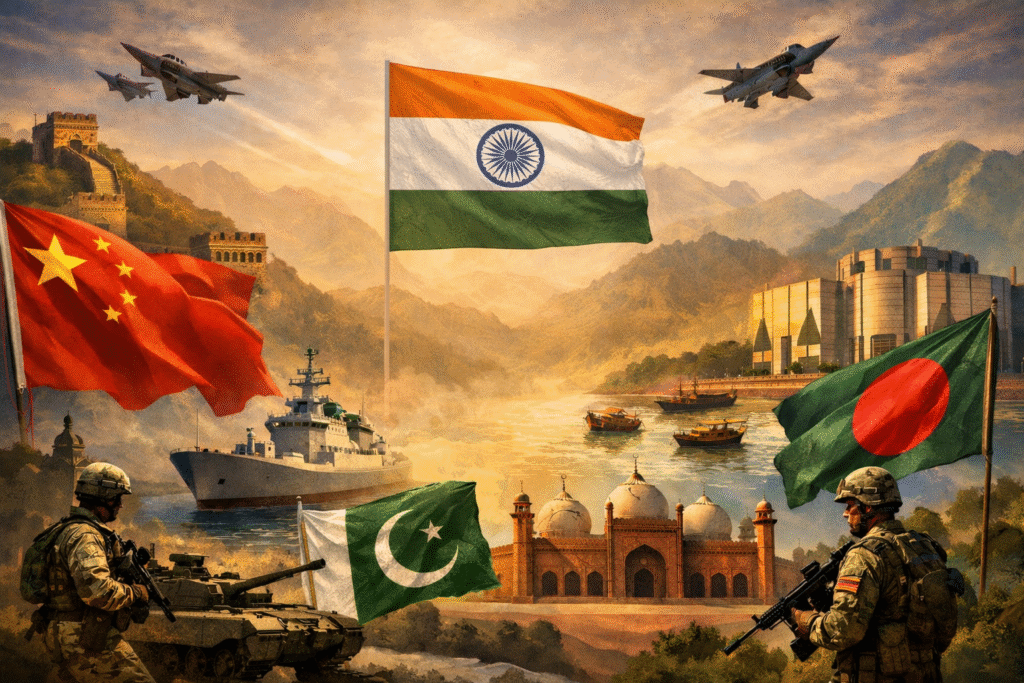
National flags, military presence, and iconic landmarks of China, Pakistan, Bangladesh, and India symbolically represent shifting power alignments and strategic competition in South Asia.
“The neighborhood first policy often becomes India first in practice”. India’s so called “Neighborhood First” policy is largely symbolic often serving as an “India First” agenda cloaked in the language of diplomacy and cooperation. While New Delhi projects itself as a benign regional leader but the actual picture is different, its action speak of coercion, aggressive policies, selective engagement, and hegemony. India is inclined to act primarily for its own national interests.
Historically, South Asia has been dominated by India’s aspirations. India has ascendency of its strong economy, geopolitical progress, and technological progress to assert itself regionally and globally. India has consistent in planning the strategies to remain dominant in the region, often shelving its neighbors especially sidelining Pakistan through diplomatic activism on multilateral forums. Its alignment with anti-China blocs like the Quad, and ongoing military advancement also contributing in the sidelining of its neighbors. Logically, if a single state monopolizes regional decision making, neighbors inevitably look for counterweights to safeguard their autonomy.
Moreover, after the Pahalgam incident BJP-led India is working on increasing of its defence system, due to its rivalry with Pakistan. According to Al Jazeera, India’s defence budget for the 2025-2026 fiscal year, running from April to March, was allocated at $78.7 billion, up nearly 10% as compared to the previous year, and the country has signaled plans to further spend in military in their upcoming budget. However, massive arms imports do not necessarily guarantee security and creating security dilemma ; they can also provoke neighboring states to form balancing coalitions in response to India’s military edge.
Additionally, a major highlight published on the global arms trade by Stockholm International Peace Research Institute (SIPRI), India is ranked as a world’s second-largest importer of arms between 2020 and 2024, reflect its desires to become the so called security provider in the South Asia, Indian Ocean Region (IOR), and beyond.
Nevertheless, India’s bold posture ranging from border contradictions with China to its aggressive rhetoric toward Pakistan, territorial disputes with Nepal like Kalapani and Lipulekh and diplomatic pressure in Bangladesh has triggered regional issues. The Modi-led India is also promoting hatred for neighbors in his own country through its media. In recent pahalgam incident, Indian media outlets were assigned to blame Pakistan without any evidence and investigation. Such unilateral behavior inevitably undermine India’s credibility as a regional leader and drive neighboring states to diversify their strategic partnerships.
The enduring China-Pakistan relations are often described by the famous quote “Higher than the mountains, deeper than the oceans, stronger than steel, and sweeter than honey. Rooted in mutual trust, aligned strategic interest and steadfast support at the times of crisis, this friendship has endured changing geopolitical landscapes, regional upheavals, and external pressures. The Sino-Pak alliance is one of the most long resilient strategic partnerships in Asia.
Anchored by the China Pakistan Economic Corridor (CPEC) as its flagship, this relationship extends well into defence collaboration. China has become the largest arms provider of Pakistan, and their collaborative military exercises, technology sharing, and deepened intelligence cooperation. Apart from the economic interests, the partnerships reflects common strategic objectives: countering India’s dominance, maintaining a balance of power in South Asia, and pushing back US’s interference in the region.
Bangladesh has emerged as the most intriguing player in this strategic triangle. The China-Pakistan-Bangladesh triangle holds significant strategic influence, shaping the dynamics of regional geopolitics. The Belt and Road initiative (BRI) serves as a vital infrastructure initiative, strengthening connectivity between China, Pakistan, and potentially Bangladesh, while enhancing economic development and regional integration. While having strong economic ties with India, the interference of India in internal affairs of Bangladesh particularly during the tenure of Sheikh Hasina is pushing Dhaka toward alternative strategic alignment.
Furthermore, On 19 June 2025, held a trilateral meeting in Kunming. However, all parties denied forming an alliance and only focused on economic cooperation. There are reports that future talks may invite Nepal, Maldives, Sri Lanka, and other countries led by China to foster economic cooperation and exchange among South Asian nations replacing the inoperative South Asian Association for Regional Cooperation (SAARC). India is unlikely to join these talks.
After setbacks in the Shanghai Cooperation Organization (SCO), and BRICS, China is distancing itself from India in the International affairs. China is strategically positioning itself in South Asia. Not just only economic aid China is supplying Pakistan and Bangladesh with appropriate weapons to protect them especially from India’s coercion. For example, China has supplied submarine support vessel BNS Sheikh Hasina to Bangladesh, complementing on its earlier submarine sales, a clear example of how Beijing is bolstering India’s neighbors militarily to counter New Delhi’s coercive stance. Due to Modi’s Hindutva-influenced foreign policy, all South Asian countries are gradually distancing themselves with India and aligning with China.
Soon after the China-Pakistan-Bangladesh meeting, According to The News International, the Indian Chief of Defence Staff, General Anil Chauhan stated at an event organized by the Observer Research Foundation that the “Possible convergence of interest among China, Pakistan, and Bangladesh may result in serious implications for India’s stability and security dynamics”. He has warned of a possible strategic convergence between China, Pakistan, and Bangladesh.
However, his statement can be seen as an expression of India’s security dilemma and insecurity over shifting regional dominance. Some of the Chinese infrastructure projects are located near India’s strategically sensitive northeastern corridor. India views any independent step by a neighboring state as a threat to its regional dominance. India’s insecurity over the China-Pakistan-Bangladesh triangle mirrors an outdated regional mindset that opposes multi polarity and coordination outside its sphere. Instead of projecting fear, India should accept this trilateral alignment as a response to its Hindutva-influenced aggressive policies and should work on collaborative diplomacy.
The emerging strategic triangle between China Pakistan, and Bangladesh should not be seen as an axis of aggression but rather a reaction to India’s growing regional assertiveness and harsh policies that can exclude its neighboring countries from meaningful cooperation. As India persists to project its dominance through military advancement, diplomatic pressure, and ideological narratives rooted from Hindutva, neighboring countries are gradually inclining towards alternative alliances that protect their sovereignty, foster economic progress, and uphold regional balance in the South Asian region.