“Strategos” Over Attrition: An Athenian Approach to Pakistan’s Two-Front Challenge
Strategos" Over Attrition: An Athenian Approach to Pakistan's Two-Front Challenge
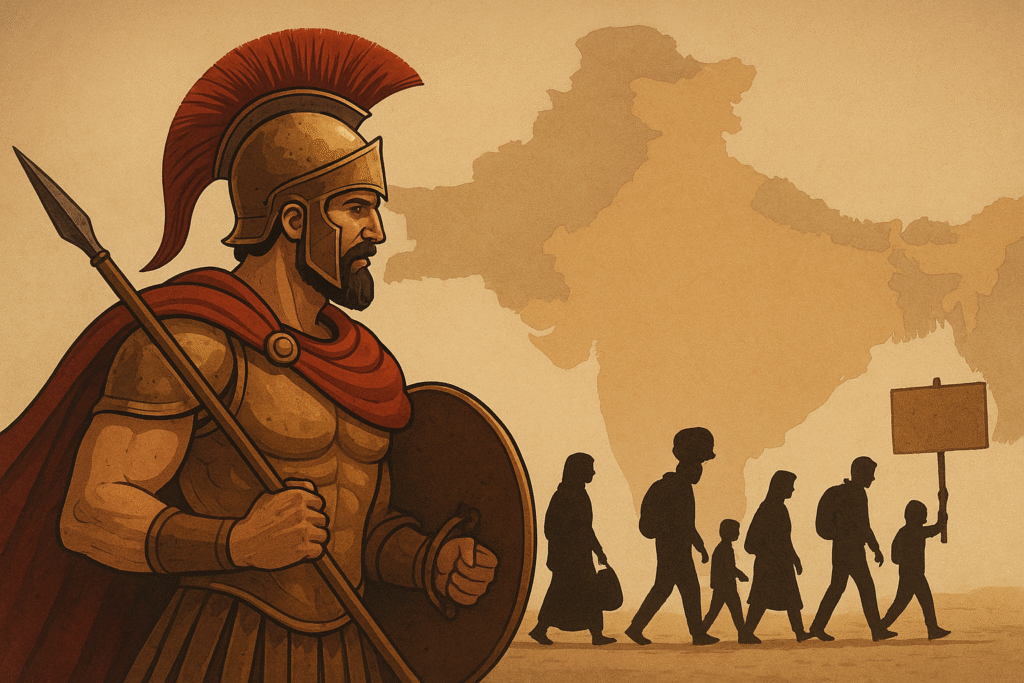
The word “strategy” comes from “strategos”, meaning a “divine spark”, a higher form of thinking that allows a person to outwit an opponent. This spark is not innate; it is cultivated through experience, wisdom, and discipline. Humans may be naturally inclined toward tactics, using what they have to achieve immediate goals, but “strategos” operates on a different plane. The ancient Greeks understood this distinction. That is why, before battle, they went not to the temple of Ares, the god of war, but to the temple of Athena, the goddess of wisdom. They knew that victory depended not on brute force but on the clarity of mind behind it.
My fascination with this distinction began early. Growing up with the novels of Naseem Hijazi, I came across a line that stayed with me forever: “The use of force is the biggest weakness of the powerful.” Years later, while studying Diplomacy and Strategic Studies, I encountered Sun Tzu. His ideas instantly connected with that earlier insight. Sun Tzu taught that “the supreme art of war is to subdue the enemy without fighting”. In other words, the greatest victories are won before swords are drawn. This principle captures the very essence of “strategos”, victory
through wisdom, not destruction.
As students of International Relations, however, we know that the real world rarely performs at the level of Athena. The realist paradigm dominates an anarchic international system. Power, interests, and insecurity drive state behavior. In such an environment, attrition often becomes the preferred method of decision-makers. Clausewitz reminds us that war is only an extension of policy by violent means; it emerges when political aims collide and diplomacy fails. This theoretical insight helps us understand the tragic trajectory of Pakistan-Afghan, Pak-India
relations, where historical grievances, colonial legacies, and structural mistrust combine to produce repeated crises.
Afghanistan and Pakistan share religion, culture, folklore, and heroes, yet their bilateral relationship has remained hostage to a colonial border: the Durand Line. Pakistan inherited this boundary from the British, while Afghan leaders ,from monarchy to communis to IEA regimes, refused to accept it. Afghanistan opposed Pakistan’s entry into the UN and supported the idea of “Pashtunistan,” largely with Indian encouragement. But forgot that the world’s largest Pashtun population lives on Pakistan’s side of the border, and it was these very Pashtuns who
rejected the Afghan narrative and defended Pakistan’s territorial integrity. Through the decades, successive Afghan governments interfered in Baluchistan and the Northwest Frontier province, presently Khyber Pakhtunkhwa. Pakistan, meanwhile, received Afghan refugees, offered shelter during the Soviet invasion, and carried the economic and social burden of a war that was not its own.
After 9/11, when Pakistan was forced by strategic realities to join the US-led coalition, Afghan soil again became a platform for Indian proxies who targeted Pakistan. Despite over 80,000 casualties and massive economic losses, Pakistan continued hosting millions of Afghans. Yet the Western-backed Kabul governments reciprocated with accusations, hostility, and support for anti-Pakistan militants. By 2021, when the US withdrew and the Islamic Emirate of Afghanistan (IEA) rose to power, Pakistan hoped for a reset. A Pashtun-dominated Afghan government , free from Indian influence, seemed like an opportunity to stabilize the region. Instead, the opposite happened.
The new IEA leadership turned hostile, allowing anti-Pakistan militants to regroup and intensify attacks. Tensions escalated along the Durand Line, and after the October clashes and the recent tragic attack on the FC Headquarters in which Afghan militants were involve, relations has deteriorated further. IEA is displaying passive defence by accusing Pakistan of targeting khost , Paktika and Nooristan . Afghan social media, amplified by Indian platforms, began constructing an anti-Pakistan narrative using doctored or outdated images, yet another front in information warfare.
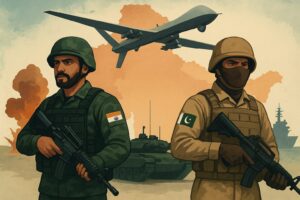
While Pakistan struggled with a volatile western frontier, the eastern border witnessed a different but equally dangerous escalation. Unable to digest the outcome of the May 2025 clashes, the Indian government has embarked on a campaign of military signaling, NOTAMs, NAVAREA warnings, and provocative statements by serving generals. The aggressive tone of India’s military officers is surprising even to those familiar with professional military norms; it reflected political hysteria , frustration and sense of defeat rather than strategic maturity.
Rajnath Singh’s irresponsible remarks about Sindh has further exposed India’s political bankruptcy. Thus, by late 2025, Pakistan finding itself encircled not by coincidence but by design. On the western border, the IEA ,proud of defeating three superpowers in its own home tuft ,through guerrilla tactics has begun to behave as if Pakistan were another occupying force. On the eastern border, India nurtured dreams of “Sindoor-02,” hoping the IEA would keep Pakistan militarily stretched. For the first time in decades, both adversaries, Hindutva India and the Islamist IEA, aligned in sentiment and behavior. Both misread Pakistan’s internal dynamics, and both are driven by their own utopian fantasies.
This creates the heart of Pakistan’s current dilemma: a two-front entanglement. The IEA hopes to bleed Pakistan through prolonged sub-conventional attrition, while India waits to exploit any sign of weakness in the east. The IEA finds that anti-Pakistan rhetoric wins local support among an unhappy Afghan population. India sees an opportunity to revive its strategic depth through Afghan territory. The result is a coordinated, mutually reinforcing challenge to Pakistan’s security. At this juncture, returning to Sun Tzu becomes essential. Pakistan must avoid being drawn into the battlefield chosen by its adversaries. As a nuclear state with established deterrence, Pakistan has no reason to fight a war on terms dictated by the IEA or India. Instead, it should embrace the indirect approach, the Athenian way. The IEA suffers from severe legitimacy issues. Supporting groups like the NRF for calibrated political pressure, without heavy reliance on force, would undercut the IEA without inflaming Afghan public sentiment. Likewise, after Rajnath Singh’s threats, Pakistan has every right to adopt policies that mirror Indian
interference, but selectively and intelligently.
Moreover, Afghanistan’s internal ethnic mosaic provides natural leverage. The IEA’s refusal to accept the Durand Line threatens the demographic balance inside Afghanistan itself, where Tajiks, Uzbeks, and Hazaras fear Pashtun domination. All regional players, China, Iran, Russia, and the Central Asian states are concerned about IEA’s destabilizing approach. This creates a strategic opening for Pakistan to build a consensus around a representative Afghan government that reflects all ethnicities, not just one faction. Stability in Afghanistan benefits every neighbor.
Sun Tzu said that the highest form of warfare is attacking the enemy’s strategy, not their forces If Pakistan understands the India-IEA plan, an extended two-front exhaustion, then countering it becomes easier. Expose the nexus, deny them their propaganda space, avoid direct attrition, strengthen internal unity, and work with regional partners for a long-term political settlement in Afghanistan. Victory will not come from Ares’ anger, but from Athena’s wisdom. In the end, Pakistan’s strategic success lies in embracing “strategos” ,the divine spark of foresight, patience, and indirect power. The path is challenging, but the opportunities are many. As history shows, nations that endure are those that combine strength with wisdom. Pakistan must do the same.
Disclaimer: The views expressed in this article are those of the author and do not necessarily reflect the policy or position of the Global Stratagem Insight (GSI).