Revolution in Military Affairs 2.0 (RMA 2.0): An Era of Uncertainty?
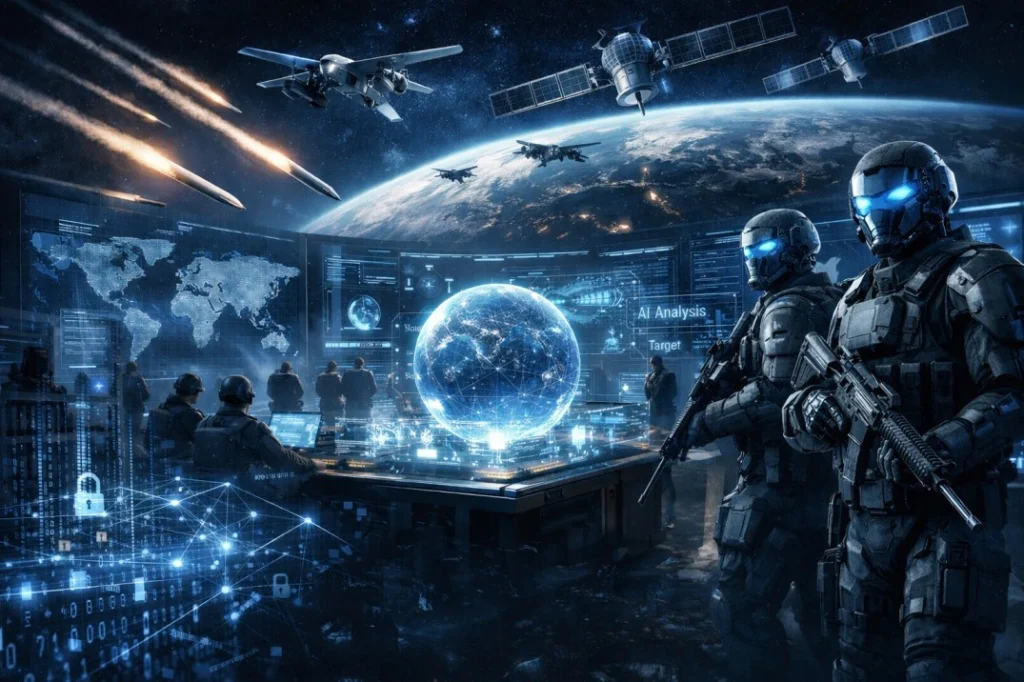
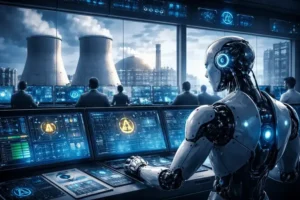
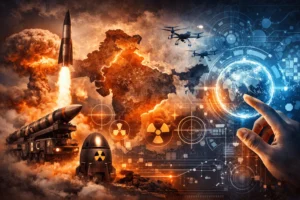
A visualization of Revolution in Military Affairs (RMA) 2.0, showcasing AI-driven warfare, autonomous drones, hypersonic missiles, and space-based technologies.
Revolution in Military Affairs (RMA) has always remained central to the idea of warfare and human evolution. The RMA is the active blueprint for the contemporary revolution in global security. Traditionally RMA focused on smart bombs, weapons, computerisation, long-range weapons, precision and destruction. However, the RMA 2.0 or the AI-RMA is mainly defined by the shift from human-led precision to machine-led autonomy. This includes Artificial Intelligence (AI), cyber and electronic warfare, cognitive warfare, quantum computing, space weaponization, and autonomous systems. Theorists are of the opinion that the pace of RMA in both theoretical and technological domains have changed the landscape and rulebook of contemporary warfare. The influence of RMA can be broken down into four transformative shifts.
Initially RMA (articulated in the 1990s) revolved around the notion of quality. The RMA 2.0 considers speed as a game changer. Resultantly, warfare is approaching towards a “human-out-of-the-loop” framework. The ability to engage targets at “machine speed,” has rendered traditional human-centric decision cycles as too slow to survive technological advancement. Despite all the technological development, human judgement leads the course of war. Theorists believe that still technology is not a substitute to human control. AI and autonomous systems can compress reaction time, but the absence of human oversight transforms deterrence into automation rather than decision. The threat of speed and machine precision has intensified the already intense security dilema in existing security structure. In regions like South Asia, such systems could act faster than diplomacy, raising the risk of escalation without intent. This indicates upon complications especially when whole premise of deterrence has been built upon “decision.” Apparently, AI-enabled command and control systems are revolutionizing decision-making but they have narrowed the space for reflection and democratic processes. Machines process information faster than institutional deliberations, creating a dangerous gap between information and wisdom.
Started from Military Industrial Complexes (MICs) now commercialization of military power is considered as force multiplier both in military and financial terms. Although the monopoly of developed world over technology has led to the technological inequality. Such strategic dependence and control over technological proliferation has redefined the role of middle powers. It may strengthens the politics of poles and divide between haves and have-nots in international politics. The post-colonial states operating under stability-instability paradox have found themselves in a commitment trap to develop indigenous capabilities in RMA 2.0 as an essential to protect their autonomy and sovereignty. For instance, Tactical Network-Centric Warfare (T-NCW) allows smaller forces (middle powers) to achieve the desired precision and situational awareness at cost effective rates, enabling their Long-range strike capabilities.
During 1990s RMA’s primary focus was “networking” the battlefield (connecting a sensor to a shooter). In 2026, the challenge is not connecting them but processing the “data deluge.” The “System of Systems (SOS)” concept is the foundation for Multi-Domain Operations (MDO) and Joint All-Domain Command and Control (JADC2). The concept of SoS is a collection of independent, task-oriented systems that pool their resources and capabilities to create a new, and more complex system. Now the warfare is focused on “Decision Advantage” to define success. Modern militaries are using AI and Edge Computing; modern militaries fuse data from space, cyber, and physical sensors instantly to create a “transparent battlefield” where movement is almost impossible to hide while reducing the element of surprise.
Traditionally RMA was about kinetic destruction. However, now it includes non-kinetic and psychological dimensions to effectively frame cognitive warfare. The use of AI-driven deep-fakes, cyber-attacks, and algorithmic social engineering to bypass physical defenses entirely. The goal is to “win without fighting” by paralyzing an enemy’s political will or distorting their perception of reality. Notably historically all strategists described it as strategic excellence. Deterrence in the 21st century is no longer about counting missiles or warheads. It is about who controls data, algorithms, and quantum networks. Digital dominance has become a significant component of strategic advantage along with the destructive capacity.
Those layers ranges from military, political, digital, and electronic to perceptual domains however, often without formal declarations. As the result, the boundaries separating peace and conflict are fading fast, hybrid conflicts are on the rise and grey zone conflicts have become rational choice. Moreover, the militarization of orbits, inclusion of civilian space programs and counter-space systems are some of the new spheres of warfare.
Comparison: Classic RMA vs. RMA 2.0
| Feature | Classic RMA (1990s–2010s) | Contemporary Revolution (2020s–2026) |
| Key Driver | Stealth & GPS Precision | AI, Robotics, & Big Data |
| Speed | Near Real-Time (minutes) | Machine Speed (milliseconds) |
| Primary Domain | Air, Land, Sea | Multi-Domain (Cyber, Space, Cognitive) |
| Main Actor | Nation-States (High Budget) | State & Non-state (Commercial Tech) |
| Cost | Billion-dollar platforms | Thousand-dollar |
| Impact | Tactical | Strategic |
The realities of Cold War era have been altered under new dimensions of global order. Similarly, the arms control treaties signed during cold war are unable to manage and regularize decentralized, dual-use, and AI-driven systems, and RMA 2.0. There is an urgent need for adaptive verification regimes that reflect the pace and complexity of modern technologies. However, the significance of state’s behaviour cannot be over ruled or undermined. The concept of “responsible use” should be articulated under international law and international humanitarian law as innovation must be guided by ethics, transparency, and restraint. Without preparing international order for RMA 2.0, the very tools to ensure security may become the sources of instability.
The views are of author’s own and should not be attributed to her institute.