PAK–KSA Landmark SMDA: Implications for Regional and Global Order
Khawaja Touqeer, Ahmad December 1, 2025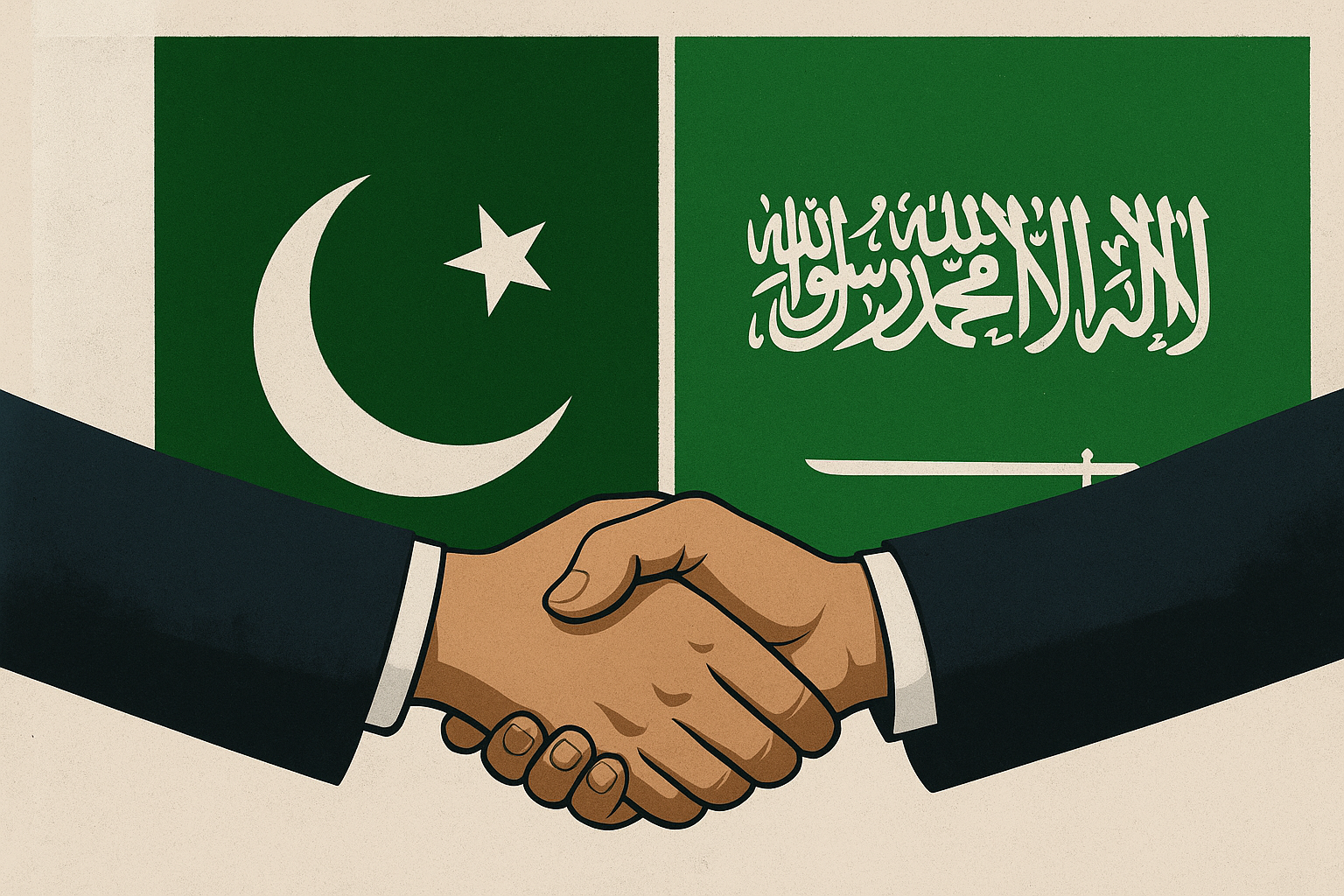
A diplomatic handshake set against the national flags of Pakistan and Saudi Arabia, symbolizing strengthened defense cooperation and a deepening strategic partnership.
On September 17th Pakistan and Kingdom of Saudi Arabia finally came up with a landmark Strategic Mutual Defense Agreement SMDA and institutionalized there long-standing ties of cooperation and brotherhood. This achievement arose two days after the upholding of an extraordinary joint session of Arab League and OIC that was called in the wake of Israel’s attack on Qatari capital Doha. From the strands of 1967 and 1982 cooperation in defense, with this recent Mutual Defense Agreement both states have transformed their deep rooted and historic ties into a comprehensive strategic partnership.
SMDA explores avenues of cooperation between Pakistan and Saudi Arabia in means of military and defense in order to ensure state’s sovereignty and security amidst disruptive global dynamics. Although credentials of the agreement have not been made public yet official statements from both ends have confirmed certain scopes of integration. The exposed clauses determine it to be merely a defensive pact that will utilize all means to strengthen joint deterrence against any aggression. SMDA emphasizes a comprehensive spectrum of cooperation between both states including domains from intelligence sharing, joint military exercises towards training forces, and technological collaboration.
The cardinal clause of SMDA and the most debated one is ‘the aggression against one state will be considered as the aggression against both’ that signifies values of collective security and has raised alarms in various circles. Although terms of ‘nuclear sharing’ and ‘nuclear umbrella’ have not been explicitly propagated yet, experts believe nukes to be the core of this pact and necessary for extended deterrence and strategic signaling. Quoting Dr Jaspal ‘If a nuclear-armed state constitutes a defence pact with any state, its nuclear weapons have an implicit or explicit connotation’.
In pretext of this development there are multiple factors that have eventually culminated in formulation of SMDA and reunion of the Muslim states. Foremost is the failure of the international order and frameworks to terminate the Gaza genocide and to stop the Israeli aggression. And the White House being obliged to Netanyahu’s dictatorship has ultimately disrupted the values of global peace and prosperity. Under ‘Greater Israel Plan’ Arabs have realized that if this continuous Israeli aggression and occupation is not put in account it will ultimately risk the survival of many Arab states as well. Moreover, Israeli attack on Qatar despite US security guarantees, surveillance and bilateral agreements have depicted the over-reliance of Arabs over the US for their security, predominantly in context of Israel.
Pakistan’s military success vis a vis India and strong diplomatic ventures with US, China, Turkey and Central Asian states have placed it in a leadership position among the Muslim World. Consequently, in the realm of evolving global anarchy Arab world has recognized and raised quests for the extended deterrence from Pakistan to ensure their survival. As Germany being a non-nuclear state and member of NPT seek arrangements of nuclear deterrence from France and US similarly KSA being a signatory of NPT can devise measures and mechanisms to prevent any territorial aggression and atomic threat. Despite nukes and capable military, Pakistan’s emotional and historic adherence with Muslim Holy Sites and their safety concern is another prime factor of this integration. It seems that Muslims have perceived challenges of the emerging global order and have emphasized the need for collective actions under regional and global setups to counter those with unity and brotherhood.
SMDA has the tendency to alter dynamics of not only the Middle East but also South Asia. Its due consequences can be far reached and can impact the contemporary global environment, and the US-led hegemonic world order. In context of Middle East this pact can serve as a protective shield for Saudi Arabia against amplifying Israeli aggression under its Greater Israel vision. Admitting US limitations in execution of its agreements and commitments underlining Arab’s security, KSA becomes the first to call for third party’s inclusion. Arabs have recognized the invincible plan of greater Israel to be a hard truth and US initiatives for normalization of relations with Israel will ultimately lead to the elimination of Arab’s statehood.
Despite assurances of the Abraham Accords ongoing Israel’s posture under Bemjamin Netanyahu pays no regard towards the international norms and its moral grounds. Until or unless Netanyahu is de-seated, there will persist a deadlock in US backed plans for normalization of Middle East. In Middle east, SMDA can serve as a corner stone for the unity of the Muslim world and might stop the territorial hunger of Israel. Expectedly more states are likely to join SMDA which may compel US to refrain Isreal from its ruthless adventures.
Under Muslim Unity there will be strong hope for settlement of the Palestinian issue as circulating Trump’s 20 points ceasefire deal is also an indication. Via Pakistan a normalization in KSA-Iran relations is highly anticipated that will unlock new patterns of cooperation and Muslim world integration. SMDA reflects an acknowledgement of Pakistan’s leadership status among the Muslim World and entitlement of “Khadim e Hareemain Shareefain” evoke profound resonance in the Muslim societies. Yet risks of horizontal proliferation and nuclear confrontation would persist if Israel kept on the same course of territorial aggression and humanitarian genocide.
SMDA can play a significant role in South Asian hostilities too, KSA siding Pakistan creates multiple barriers for Modi to execute his territorial aggression and propaganda led warfare against Pakistan. For a matter-of-fact KSA and India both enjoy chronic economic and strategic relations involving heavy mutual investments and business collaborations. About 2.5 to 3 million Indian labor is serving in Kingdom of Saudi Arabia under various national and international projects. Sharing strong bonds with KSA means having a solid sphere of influence (economic and strategic) over all Gulf states. For this sake, any act of aggression against Pakistan this time will ultimately lead towards the deterioration of relations between KSA and India.
Hence India has to pay a huge economic and strategic cost for any hostility in South Asian region against Pakistan. For Pakistan, integration with Saudi Arabia will be crucial for prolonging any future war and sustaining it against India. Dollars for military upgradation, arms collaboration, technological assistance and sustained oil supply will leverage Pakistan’s upper hand in upcoming regional crises. Contemporary international dynamics projects an indication of a broader Muslim security alliance with Pakistan assuming the leading role, warning India for any miscalculation.
Reconfiguring power structures on the global stage and the integration of Arab world with Pakistan indicates substantial shifts in the prevalent American centric global order. The contemporary inclinations also depict that US may shatter its influence over the Middle eastern world and its adjacent waters annexing about 40 percent of the world’s oil and gas trade. Despite grave economic setbacks over the Persian Gulf; China and Russia utilizing the vacuum would exercise to enhance their dominance in the Middle Eastern region. Being attributed to Pakistan there persist a chance that Arabs might get aligned with China in multiple trade and strategic pacts that will serve a huge strategic and economic loss for the Washington.
The current global order is facing immense transition and shifts towards multipolarity are in great progression. In the predominant realist framework and scope of geopolitics; alliance politics have reinvigorated with the emergence of multiple Mini-lateral security groups like AUKUS, Quad, I2U2 etc. Likewise, the formation of SMDA seems to be a continuation in the same trend. Beyond strengthening notions of regionalism across globe, consolidating Islamic bloc manifests to materialize frameworks of collective security and Muslim Identity. These building developments can pose great challenges towards norms and values of the postwar Bretton-wood system. Anyhow signing of the Strategic Mutual Defense Agreement has paved way for the essential cooperation and awaited interdependence among the Muslim World.
CITATIONS:
- Pakistan and Saudi Arabia Forge Strategic Defense Pact Amid Shifting West Asian Dynamics – The Diplomat
- Saudi Arabia and Pakistan sign mutual defense pact as Gulf Arab states grow wary of US security guarantees | CNN
- ‘Pak-KSA coop deepened after historic defence agreement’
- Saudi Arabia signs mutual defence pact with nuclear-armed Pakistan | News | Al Jazeera
- Joint Statement on the State Visit of Prime Minister of the Islamic Republic of Pakistan, Muhammad Shehbaz Sharif, to the Kingdom of Saudi Arabia
Disclaimer: The views expressed in this article are those of the author and do not necessarily reflect the policy or position of the Global Stratagem Insight (GSI).