NSS 2025 and the New World Order
U.S. National Security Strategy 2025 and its influence on the emerging global order.
Hitherto, the National Security Strategy (NSS) was a routine document. It was prepared periodically by the executive branch of the US, headed by the US President, to be sent to the legislative branch, Congress. The NSS lays down the broad strategic context for the deployment of military capabilities in conjunction with other tools of national power. Its goal was to communicate the administration’s worldwide commitments, foreign policy, implementation of the strategy, and utilising the US’s national defence capabilities to deter aggression, whilst moulding the global environment in order to provide lasting security for the American people. The NSS 2025, released by the White House during the second tenure of the US President Donald Trump, has been defined by a strategic shift and reorientation of the US’s global approach.
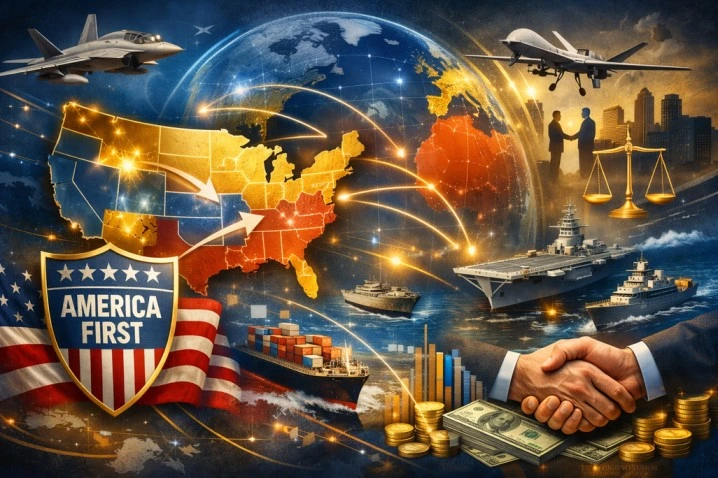
Tinged with President Trump’s campaign slogans of America First and rhetoric rooted in populism and nationalism, the NSS 2025 is markedly different from previous such documents. This is because it has presented an unadulterated view of President Trump’s new world order as transactional and unilateral, echoing the tenets of realism and a nod to the 1904 Roosevelt Corollary to the Monroe Doctrine, asserting dominance in defined spheres of influence, contrasting the erstwhile world order predicated on global hegemony and rules-based liberal free trade order.
The 29-page document has an inward-looking approach, prioritising national security, the nation-state, restricting migration, border control, burden-sharing within alliances, whilst narrowly defining US interests and putting economic interests at the centre. In that regard, the US’s reorientation towards the Western Hemisphere is prominent, asserting exclusive American influence for countering the threats of drugs and crime, migration, and China. Other regions, such as the Middle East, Africa, and the Indo-Pacific, hold a reduced place in the strategy, as focus is maintained on trade, supply chains, and investments.
The US has essentially redefined the American role as an international policeman in the NSS, and multilateralism has been put on a back foot as international institutions have been criticised as anti-American, with selective global engagement prioritised over liberal internationalism. This has wider implications for trade, national security, and inter-state relations.
The document has put economic security as an inextricable part of national security, as seen in its prioritisation of economics and instrumentalisation of foreign policy for profit maximisation, which is a great departure from prior strategies’ focus on values such as democracy and international law. In that regard, independent access to raw materials and supply chains, balanced trade, re-industrialisation, and energy dominance are sought through commercial diplomacy, wherein tariffs would be strategically used. The employment of tariffs as a sanctioning mechanism and leveraging negotiated tariff reductions has allowed the US administration to achieve its national security goals. This was seen in early February 2026 when Washington reduced tariffs on Indian goods to 18 per cent in exchange for New Delhi buying 500 million USD worth of American goods and replacing Russian oil with supply from Venezuela and the US.
A palpable shift towards realism was felt in the text of the 2025 NSS and its subsequent demonstration by Washington through the capture of Venezuelan President Nicolás Maduro and his wife under Operation Absolute Resolve, demonstrating the importance of national security for states around the world. The Venezuelan episode particularly revealed the importance of the armed forces and government to be on the same page to thwart external intervention.
With emerging transactional engagements, space has opened up for middle powers to rise and forge relations through specific issue-based coalitions. These partnerships can be formed around particular interests such as energy, trade, or climate, rather than the formation of rigid blocs.
Within the security-centric language deployed by the NSS, Pakistan has been briefly mentioned, despite increased leader-driven engagements between Islamabad and Washington in 2025 and President Trump’s reiteration of Pakistan successfully downing Indian fighter jets, with his claimed number now reaching 11. It is pertinent to recognise that although the NSS 2025 has provided an insight into the Trumpian ideology and the way his administration intends to position itself with the public, its importance should not be exaggerated, as foreign policy decisions would not be undertaken through the consultation of this document. Therefore, Pakistan remains a strategic partner of the US. It was explicitly stated by Paul Kapur, on 12 February 2026, during his address to the US Congress, where he underscored growing bilateral cooperation in critical minerals, counterterrorism, and financing of the private sector. An example is seen in the launch of a strategic economic initiative pertaining to the maintenance and redevelopment of the Roosevelt Hotel in New York.
Conclusively, to navigate an emergent world order where new rules are still taking shape, it is important for countries like Pakistan to have a proactive foreign policy, be militarily prepared to defend the country’s sovereignty, and put emphasis on geoeconomics to achieve economic resilience.