NATO’s Fate: US-Greenland Strategic Dynamics
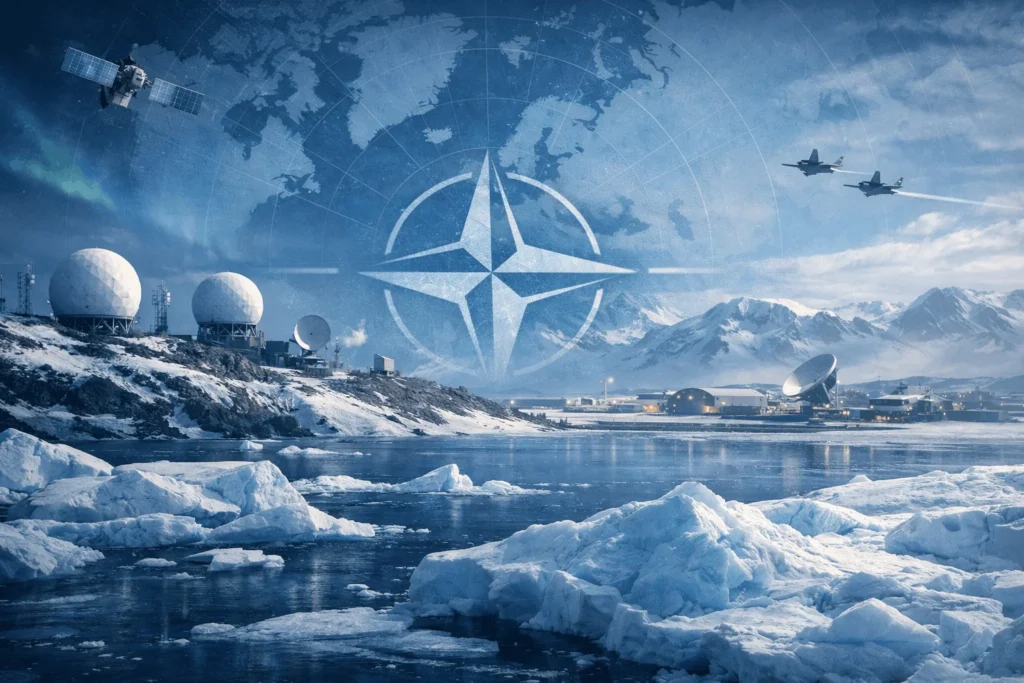
A cinematic Arctic scene of Greenland shows icy waters and snow-covered mountains framing a distant US military presence, with radar domes, satellites, and aircraft symbolizing strategic surveillance. A subtle NATO emblem and faint Arctic map overlay blend into the cool blue landscape, highlighting Greenland’s geostrategic importance and the evolving US–NATO security dynamics in the High North.
US President Donald Trump’s talk of taking over Greenland has worried the European allies and raised concerns about the possible collapse of the world’s largest military alliance. Like NATO, which currently protects Europe by linking it with the United States and Canada. European states fear that the US would stop prioritizing Europe’s security by making NATO ineffective in serving its own interests. If that happens, Europe would have to protect itself on its own. This could result in the invocation of Article 5 of NATO, which says that an attack on one is an attack on all.
Greenland is strategically so important because of its location, which connects Eurasia, North America, and the Arctic Zone, making it really important for the US and the European Union. As the global warming increases, the melting glaciers of the world’s largest island open the door for the rich minerals, which are the key focus of Trump elsewhere, including in his deal with Ukraine. However, the US president has said, “We need Greenland for national security, not minerals.” The US has described the threats that it perceives from the rival powers as a reason to annex Greenland. Trump has said that “if we don’t take Greenland, Russia or China will”.
After Trump captured Venezuela’s president on January 3rd, he became more aggressive and bolder. This explicitly shows that now Trump can intervene with the sovereignty of the states, breaking international law, and can annex Greenland, which belongs to Denmark but governs itself. Incase US attacks Greenland, it will heavily affect NATO because Greenland belongs to Denmark, which is a member state of NATO, and NATO states aren’t supposed to attack each other. Anna Wieslander of the Atlantic Council said that, keeping in mind what happened in Venezuela, the US’s intention to control Greenland shows that it wants to influence the whole region, as the location of Greenland on North Atlantic says it all.
Experts say that if the US were to attack Greenland, it would help Russia a lot in its war with Ukraine, because of the reduced pressure from NATO due to its weakness. The argument is that the survival of NATO is at stake if the US attacks Greenland, but such an action would be contrary to US national interests. The United States’ National Security Strategy (NSS) quotes that: Trump’s Foreign policy is not grounded in traditional political ideology. It is motivated above all by what works for America—or, in two words, “America First.”
If we look into this foreign policy aspect, the US would never create strategic instability with Russia, which could result if NATO becomes ineffective due to European states’ disagreement with the US regarding Greenland’s annexation. As the US heavily relies on its military bases in European states (More than 40 US military bases span the continent, from northwestern Greenland to Turkey’s border with Russia) for its strategic stability with Russia, straining Relationships with European states could give power to the US’s rival.
To understand the fate of NATO, we must look at the perspective of the member states of NATO regarding Trump’s intention towards Greenland’s annexation. Denmark’s Prime Minister Mette Frederiksen criticized Trump and said that: “US attack on Greenland would mean the end of NATO”. Germany, Sweden, France, Norway, the Netherlands, and Finland have all since confirmed they are sending military personnel to Greenland this week. Canada and France have also said they plan to open consulates in Nuuk, Greenland’s capital, in the coming weeks.
It is not unusual that NATO states are sending troops to other NATO countries for training, but the timing and symbolism of the statements from the NATO states show the solidarity among the NATO members.
This solidarity also reflects the personal interests of the respective parties. European states heavily rely on NATO for their security concerns. If the US annexes Greenland, it would result in the breakdown of its main Security alliance. Moreover, European states largely believe in democracy, freedom, human rights, and multilateral cooperation, i.e., an ‘Island of liberalism’. If the US and Russia move away from these values, Europe would be left alone protecting these values, making itself isolated strategically and believing in “freedom and Equality” rather than “Might is right”.
On the other hand, the US wants to influence the strategically important Greenland’s resources as well as to maintain the strategic stability with Russia with the help of European states.
In all these scenarios, this situation might lead to a compromise that satisfies both sides. If the US gets access to the minerals and rare Earth metals, including more military presence, then this would let Trump declare a victory and satisfy the European states through the fact that NATO is still for their security, and Greenland hasn’t been taken over.