Gilgit-Baltistan as a Strategic Crossroads: Geopolitical Dynamics, Security Implications, and Future Pathways in South Asia
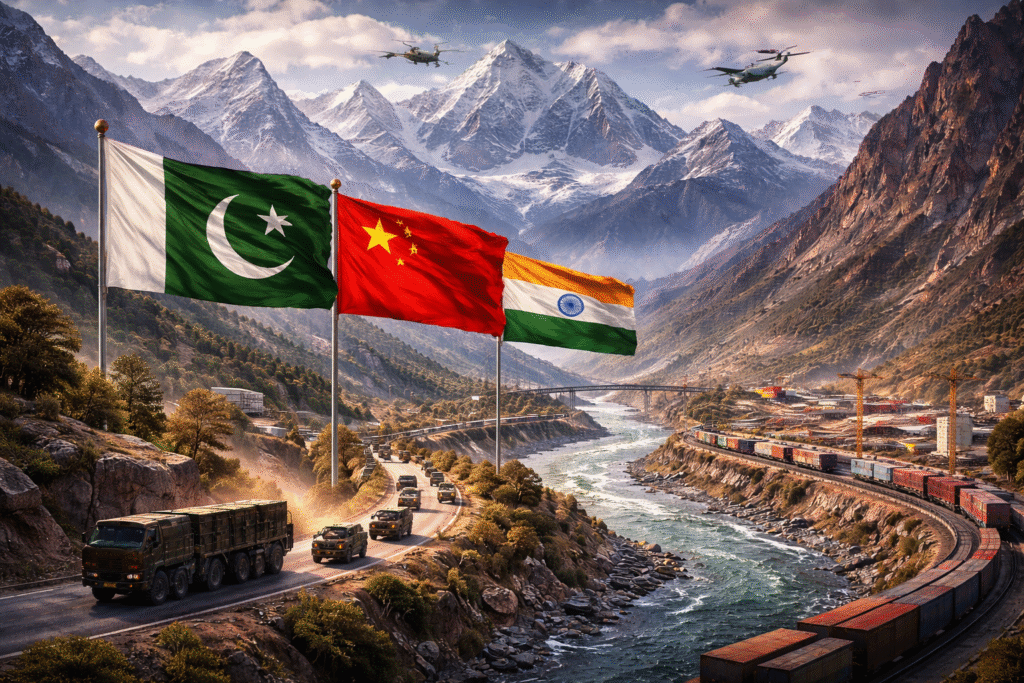
A visual representation of Gilgit-Baltistan’s strategic location linking South Asia, Central Asia, and Western China, highlighting its role in regional connectivity, security dynamics, and emerging economic and environmental challenges.
Abstract
Gilgit-Baltistan occupies a uniquely strategic position at the intersection of South Asia, Central Asia, and Western China. Its geographical location, proximity to multiple regional powers, and role in historical and contemporary connectivity corridors have long shaped its geopolitical relevance. This paper examines the geostrategic and geopolitical importance of Gilgit-Baltistan through classical geopolitical frameworks, particularly Mackinder’s Heartland Theory and Spykman’s Rimland Theory. It analyzes how regional contestation involving Pakistan, India, and China influences the security environment of the region while also exploring economic potential, environmental vulnerability, and governance-related challenges. The study further assesses the perspectives of local populations regarding political status and future governance arrangements. It argues that Gilgit-Baltistan’s long-term stability depends not solely on resolving territorial disputes but also on inclusive governance, regional cooperation, and the integration of non-traditional security dimensions such as climate change and human security. The paper concludes that Gilgit-Baltistan has the potential to transition from a zone of strategic competition into a bridge for regional connectivity and cooperation if supported by sustainable and conflict-sensitive policies.
Introduction
Geography has historically played a decisive role in shaping political power, security outcomes, and patterns of regional interaction. Few regions exemplify this reality as clearly as Gilgit-Baltistan. Located in the northernmost part of Pakistan, Gilgit-Baltistan lies at the convergence of South Asia, Central Asia, and China, bordering China’s Xinjiang region, Afghanistan’s Wakhan Corridor, and Indian-administered territories of Jammu and Kashmir and Ladakh. This positioning has rendered the region geopolitically significant for centuries, from ancient trade routes to contemporary strategic corridors.
Despite its strategic relevance, Gilgit-Baltistan remains politically contested and administratively distinct. Its association with the broader Jammu and Kashmir dispute has shaped both its domestic governance arrangements and its position within regional geopolitics. While Pakistan administers the region, India maintains claims over it as part of the former princely state of Jammu and Kashmir, and China’s involvement is largely driven by economic connectivity and regional stability considerations.
This paper seeks to examine the geostrategic and geopolitical importance of Gilgit-Baltistan in a comprehensive and analytical manner. Rather than adopting a purely state-centric or adversarial perspective, the study integrates traditional geopolitical analysis with contemporary security concerns, including economic development, climate vulnerability, and human security. The central research questions guiding this study are:
- How does Gilgit-Baltistan’s geographical and strategic location shape regional security dynamics in South Asia?
- What future pathways can enhance stability, development, and regional cooperation in the region?
Geographical Setting and Strategic Location
Gilgit-Baltistan covers an area of approximately 72,000–74,000 square kilometers and is characterized by rugged terrain dominated by some of the world’s highest mountain ranges, including the Karakoram, Himalaya, and Hindu Kush. The region hosts five of the world’s fourteen peaks exceeding 8,000 meters, including K2, Gasherbrum I and II, and Broad Peak. In addition, it contains one of the highest concentrations of glaciers outside the polar regions, making it ecologically significant and environmentally sensitive.
The region’s geography has historically limited accessibility while simultaneously enhancing its strategic value. Mountain passes such as Khunjerab, Babusar, Shandur, Burzil, and Mintaka have served as conduits for trade, migration, and military movement. These routes once formed part of the ancient Silk Road network and continue to shape contemporary connectivity initiatives.
Gilgit-Baltistan’s location provides direct land connectivity between Pakistan and China and indirect access to Central Asia and Afghanistan. The Wakhan Corridor, although narrow and sparsely populated, further enhances the region’s strategic relevance by linking South and Central Asia. This geographical positioning places Gilgit-Baltistan at the center of competing strategic interests, making it both a corridor of opportunity and a zone of vulnerability.
Historical Context and Political Evolution
The political history of Gilgit-Baltistan reflects the broader dynamics of imperial competition, colonial administration, and post-colonial state formation. Historically, the region was ruled by local principalities and later incorporated into larger empires, including the Mughals and the Sikh Empire. In the 19th century, it became part of the princely state of Jammu and Kashmir under Dogra rule, administered indirectly by the British Empire.
Following the partition of British India in 1947, Gilgit-Baltistan experienced a distinct political trajectory. Local forces revolted against Dogra rule, and the region came under Pakistani administration. However, unlike Pakistan’s provinces, Gilgit-Baltistan was governed through special administrative arrangements due to its linkage with the unresolved Kashmir dispute.
Over the decades, various governance frameworks were introduced, culminating in the Gilgit-Baltistan Empowerment and Self-Governance Order of 2009 and subsequent reforms. These measures enhanced local representation through an elected legislative assembly but stopped short of granting full constitutional status. As a result, debates over political representation, autonomy, and constitutional rights remain central to local political discourse.
Geopolitical and Geostrategic Importance
Gilgit-Baltistan’s geostrategic importance derives from a combination of location, connectivity, and resource potential. Situated between nuclear-armed states and emerging economic powers, the region functions as a strategic buffer as well as a transit corridor. Classical geopolitics helps illuminate this role.
From Mackinder’s Heartland perspective, control over inner Eurasian spaces influences global power dynamics. While Gilgit-Baltistan is not part of the heartland itself, it lies along critical access routes connecting rimland regions to the Eurasian interior. Spykman’s Rimland Theory further underscores the importance of such peripheral zones, where control over connectivity and coastal-adjacent corridors shapes regional influence.
In contemporary terms, Gilgit-Baltistan’s strategic relevance has been amplified by large-scale infrastructure projects, particularly the China–Pakistan Economic Corridor (CPEC). As the northern gateway of CPEC, the region connects China’s Xinjiang province to Pakistan’s ports, integrating it into broader Belt and Road Initiative (BRI) networks. This connectivity has elevated Gilgit-Baltistan’s importance not only for Pakistan and China but also for regional stability and economic integration.
Economic Potential and Resource Dimensions
Gilgit-Baltistan possesses substantial economic potential, primarily in the sectors of hydropower generation, tourism, and mineral resources. Owing to its unique geography and natural endowments, the region is widely regarded as a critical component of Pakistan’s long-term economic and energy strategy.
Hydropower Potential
The Indus River system and its tributaries—originating largely from the glaciated landscapes of Gilgit-Baltistan—provide the region with exceptional hydropower potential. Estimates suggest that Gilgit-Baltistan alone holds approximately 40,000 megawatts (MW) of technically exploitable hydropower capacity, accounting for a significant share of Pakistan’s total hydropower potential. Major existing and proposed projects in and around the region include Diamer–Bhasha Dam (≈4,500 MW), Bunji Dam (≈7,100 MW), Skardu Dam (≈1,200 MW), Dasu Dam (≈4,320 MW), and Tangus and Yulbo hydropower projects, among others.
If systematically developed, this capacity could not only help address Pakistan’s chronic energy shortages but also generate long-term revenue through domestic supply and regional energy integration. Despite this potential, progress has been constrained by financial limitations, environmental concerns, political sensitivities, and infrastructural challenges.
Tourism Potential
Tourism represents one of the most promising and underutilized sectors of Gilgit-Baltistan’s economy. The region’s dramatic landscapes, including world-renowned peaks such as K2, Nanga Parbat, Gasherbrum, and Rakaposhi, along with extensive trekking routes, glaciers, alpine lakes, and cultural heritage sites, make it a major destination for adventure and eco-tourism.
Prior to recent disruptions, Gilgit-Baltistan attracted over one million domestic tourists annually, while international tourist arrivals—particularly mountaineers, trekkers, and adventure travelers—were steadily increasing. Conservative estimates suggest that with improved infrastructure, environmental management, and security conditions, the tourism sector could generate annual revenues exceeding USD 1–2 billion, while creating large scale employment opportunities for local communities.
Beyond direct economic gains, tourism also functions as a form of soft power, enhancing Pakistan’s international image and fostering people-to-people exchanges. However, challenges such as limited transport connectivity, inadequate hospitality infrastructure, environmental degradation, and climate-related risks continue to hinder the sector’s full realization.
Mineral Resources
Gilgit-Baltistan is rich in both metallic and non-metallic mineral resources, although much of this potential remains underexplored. The region is known to host deposits of gold, copper, iron ore, silver, lead, zinc, and rare gemstones, alongside industrial minerals such as marble, granite, quartz, and limestone. Additionally, Gilgit-Baltistan is internationally recognized for its gemstone industry, producing high-value stones including aquamarine, ruby, emerald, topaz, tourmaline, and garnet.
Available estimates indicate that hundreds of mineralized sites exist across the region, with the gemstone sector alone valued in the hundreds of millions of US dollars annually if properly regulated and marketed. However, the absence of comprehensive geological surveys, outdated extraction methods, weak regulatory frameworks, and environmental risks have significantly limited systematic development. Informal and small-scale mining practices often result in revenue losses and ecological damage.
Sustainable mineral exploitation—supported by scientific surveys, transparent governance, and environmental safeguards—could substantially enhance regional revenues while minimizing social and ecological tensions.
Towards Sustainable Economic Development
Despite its immense economic promise, Gilgit-Baltistan’s resource potential remains largely unrealized due to political uncertainty, infrastructural gaps, environmental vulnerability, and governance constraints. The strategic development of hydropower, tourism, and mineral resources requires an integrated approach that balances economic growth with environmental sustainability and local inclusion. If managed effectively, these sectors could transform Gilgit-Baltistan from a peripheral frontier into a key contributor to national development and regional economic connectivity.
Climate Change and Non-Traditional Security Challenges
In recent years, climate change has emerged as a critical non-traditional security challenge for Gilgit-Baltistan. Rapid glacial melting, glacial lake outburst floods (GLOFs), landslides, and erratic weather patterns pose serious risks to livelihoods, infrastructure, and human security. These environmental pressures intersect with existing political and economic vulnerabilities, intensifying the region’s exposure to instability.
Climate-induced disasters not only threaten local communities but also have broader regional implications, particularly for water security downstream. As a result, environmental resilience and climate adaptation have become integral components of regional security planning. Addressing these challenges requires cross-border cooperation, scientific research, and inclusive development policies.
Regional Claims and International Dimensions
The geopolitical context of Gilgit-Baltistan is shaped by competing regional narratives and strategic interests. Pakistan administers the region and views it as integral to its security and economic connectivity, particularly in relation to CPEC. India, however, asserts claims over Gilgit-Baltistan as part of the former princely state of Jammu and Kashmir, linking it to the broader Kashmir dispute.
China’s role differs in nature. Rather than asserting territorial claims, China’s engagement is primarily economic and strategic, centered on regional stability and connectivity. Beijing’s interest in Gilgit-Baltistan is closely tied to Xinjiang’s security and the success of BRI-linked infrastructure projects.
The United Nations has historically recognized the disputed status of Jammu and Kashmir, including Gilgit-Baltistan, through resolutions calling for a peaceful settlement. However, changing regional dynamics and bilateral developments have complicated the implementation of these frameworks, leaving the region in a prolonged state of political ambiguity.
Local Perspectives and Governance Debates
The people of Gilgit-Baltistan hold diverse opinions regarding the legislative and constitutional status of the region. These differing perspectives and political preferences are often viewed as a challenge to reaching a unified vision for the region’s future. To examine local attitudes, a survey based on a quantitative research method was conducted. The findings indicate that approximately 80% of respondents favored a Kashmir-type legislative assembly with autonomous authority until the broader dispute is resolved. Additionally, 70% of respondents expressed the view that Gilgit-Baltistan should be granted the status of Pakistan’s fifth province.
To further contextualize these findings, interviews were conducted with native political representatives. A similar perspective emerged during an interview with Nazim-ud-Din of Jutal, President of the Balawaristan National Front (BNF) Gilgit City. He stated that his party does not oppose the idea of Gilgit-Baltistan becoming a full constitutional province of Pakistan; however, it strongly opposes the concept of a provisional provincial setup. According to him, the provisional arrangement is perceived as a temporary measure that does not address the region’s long-term political aspirations. He emphasized that the party’s primary demands are either the granting of full constitutional provincial status to Gilgit-Baltistan or the establishment of a Kashmir-like governance framework until the dispute is conclusively resolved.
Theoretical Framework and Hypothesis
The central hypothesis of this study is that the geopolitical and geostrategic importance of Gilgit-Baltistan exerts a significant influence on regional dynamics amid competing regional claims. To examine this hypothesis, the study adopts two classical geopolitical theories: Heartland Theory and Rimland Theory, which provide a conceptual foundation for understanding the strategic relevance of geographically pivotal regions.
The Heartland Theory, proposed by British geographer Sir Halford Mackinder in 1904, posits that the interior core of Eurasia—referred to as the “heartland” constitutes the most strategically significant region in global politics and military power. Mackinder argued that control over this central landmass would enable a state to exercise disproportionate influence over surrounding regions and, ultimately, global affairs.
In contrast, the Rimland Theory, advanced by American political scientist Nicholas Spykman in 1942, emphasizes the strategic importance of coastal and peripheral regions surrounding the heartland. According to Spykman, dominance over the rimland is essential for exerting control over the heartland, as these areas serve as gateways for trade, military movement, and political influence. Both theories underscore the critical role of geography in shaping global power structures, though they differ in identifying which regions hold primary strategic value.
Theoretical Implications for Gilgit-Baltistan
Applying these theoretical frameworks to Gilgit-Baltistan highlights the region’s multifaceted strategic significance. The geopolitical and geostrategic position of Gilgit-Baltistan reflects a convergence of geographical features, natural resources, and historical connectivity, all of which have amplified its importance over time. The region has historically functioned as a corridor for ancient trade routes, including segments of the Silk Road, linking South Asia with Central Asia and beyond.
From a Rimland perspective, Gilgit-Baltistan occupies a critical intermediary space connecting major regional powers. In the contemporary context, its strategic relevance has increased substantially due to the China–Pakistan Economic Corridor (CPEC), as the region serves as a key gateway for economic and infrastructural connectivity between Pakistan and China. Moreover, Gilgit-Baltistan functions as a strategic pivot between nuclear-armed states and provides access routes toward Central Asia. Its geographical position also places it along pathways linking South Asia to Afghanistan.
Within this theoretical lens, Gilgit-Baltistan can be understood as a strategic gateway to resource-rich Central Asian regions, where control over connectivity and stability significantly shapes regional power dynamics. The application of Heartland and Rimland theories thus offers valuable insight into why Gilgit-Baltistan continues to occupy a central place in South Asia’s evolving geopolitical landscape.
Future Pathways and Policy Implications
Gilgit-Baltistan’s future will be shaped by choices made at local, national, and regional levels. Three broad pathways can be identified. First, continued strategic competition could entrench insecurity and limit development opportunities. Second, unilateral governance reforms without regional consensus may improve local administration but fail to address broader geopolitical tensions. Third, cooperative and conflict-sensitive approaches offer the most sustainable path forward.
Regional cooperation, particularly in areas such as trade, energy, tourism, and climate adaptation, can transform Gilgit-Baltistan from a contested frontier into a zone of connectivity. Strengthening local governance, ensuring political inclusion, and investing in human development are equally critical for long-term stability.
Conclusion
Gilgit-Baltistan occupies a pivotal position in South Asia’s geopolitical landscape. Its strategic location, resource potential, and role in regional connectivity make it a focal point of both opportunity and contestation. While traditional geopolitical rivalries continue to shape its external environment, emerging challenges such as climate change and human security underscore the need for a more comprehensive analytical framework.
Lastly, analyst argues that Gilgit-Baltistan’s long-term stability depends not only on resolving territorial disputes but also on inclusive governance, sustainable development, and regional cooperation. By adopting policies that integrate strategic, economic, and environmental considerations, the region can evolve from a site of competition into a bridge for peace and connectivity in a complex regional order.
Bibliography