From Deterrence Stability to Deterrence Stress: How New Technologies Are Rewriting South Asia’s Nuclear Risk Equation
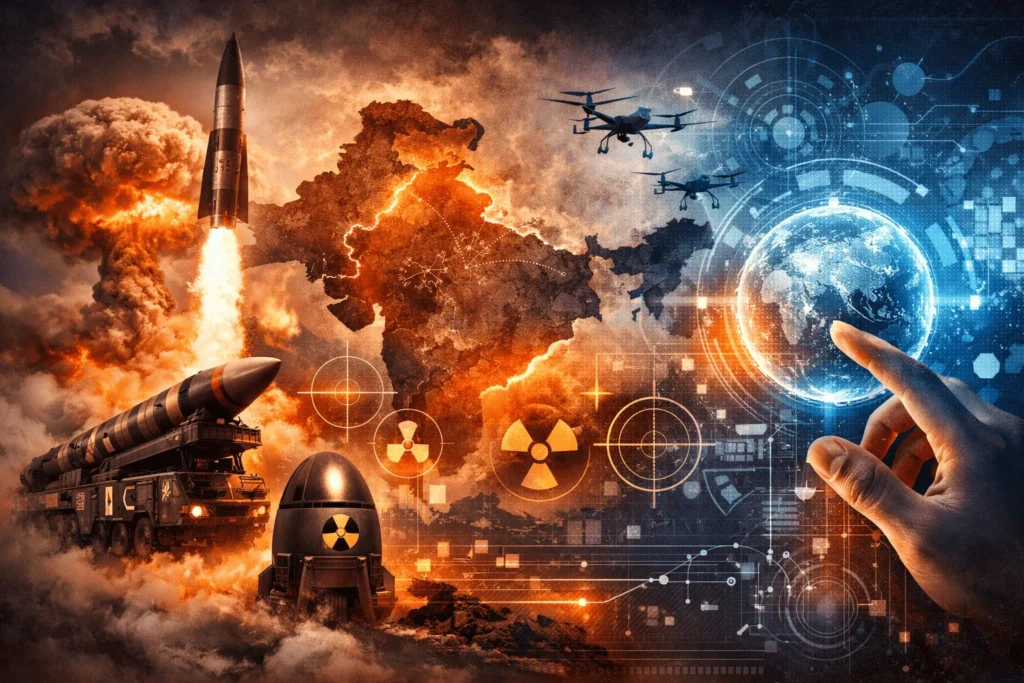
A visual representation of South Asia’s shifting nuclear landscape, where traditional missile deterrence intersects with drones, digital systems, and emerging technologies that heighten strategic risk and uncertainty..
South Asia’s nuclear order has long been described as tense yet resilient. Despite repeated crises, India and Pakistan have avoided uncontrolled escalation, reinforcing the assumption that nuclear deterrence, however fragile has remained broadly stable. This stability rested on mutual vulnerability, relatively simple force structures, and the belief that escalation could be managed through signaling, restraint, and political control.
That assumption is now under increasing strain. A combination of emerging technologies, evolving force postures, and doctrinal ambiguity is reshaping the regional nuclear environment in ways that compress decision-making timelines and complicate escalation control. Rather than signalling the collapse of deterrence, these changes point toward a more insidious condition: deterrence stress, where stability persists but under growing pressure.
Three developments are particularly consequential: the gradual introduction of MIRV-capable systems, the pursuit of ballistic missile defense (BMD), and the growing salience of tactical nuclear weapons. Together, they alter incentives, increase uncertainty, and challenge long-held assumptions about crisis stability in South Asia.
MIRVs and the Return of Counterforce Logic
India’s movement toward MIRV-capable missile systems represents a significant qualitative shift in the regional strategic balance. MIRVs allow a single missile to deliver multiple warheads against separate targets, improving efficiency while enhancing counterforce potential. Although New Delhi has not officially declared the deployment of MIRVs, test activity associated with long-range systems particularly Agni-V and follow-on variants has been widely interpreted by analysts as preparatory steps.
From an escalation-risk perspective, MIRVs matter less for their numbers than for how they are perceived. They intensify concerns about survivability, especially for Pakistan, whose nuclear forces operate under geographic compression and limited strategic depth. If one side believes its retaliatory capability could be degraded early in a conflict, crisis incentives shift toward early use or rapid escalation, even if neither side seeks war.
Research by SIPRI and other arms control institutions consistently shows that MIRVs undermine deterrence stability in asymmetric nuclear relationships by encouraging arms racing and first-strike anxieties rather than restraint. In South Asia’s already compressed escalation environment, MIRVs introduce additional stress by amplifying worst-case planning on both sides.
Ballistic Missile Defense and the Erosion of Mutual Vulnerability
India’s pursuit of a layered ballistic missile defence architecture further contributes to deterrence stress. While officially framed as defensive and limited, BMD alters strategic calculations by raising doubts real or perceived about the credibility of retaliation. Even imperfect missile defences can destabilize deterrence if adversaries believe their second-strike capability may be partially neutralized.
Pakistan has repeatedly expressed concern that Indian BMD efforts weaken mutual vulnerability, a foundational pillar of deterrence stability. In response, Islamabad has invested in countermeasures, including cruise missiles, MIRV development, manoeuvrable re-entry vehicles, and penetration aids designed to overwhelm defences.
Studies from the Carnegie Endowment and RAND Corporation demonstrate that missile defence deployments frequently stimulate vertical and horizontal proliferation, as adversaries seek to restore deterrence credibility. In South Asia, BMD thus functions less as a stabilizer and more as a driver of competitive adaptation, increasing uncertainty during crises rather than reducing risk.
Tactical Nuclear Weapons and Threshold Ambiguity
The introduction and operationalization of tactical nuclear systems add a more immediate escalation risk. Pakistan’s Nasr (Hatf-IX) missile system, intended to deter limited conventional incursions, reflects an effort to offset India’s conventional military advantages and evolving operational concepts.
However, tactical nuclear weapons inherently blur escalation thresholds. Their shorter ranges, potential forward deployment, and integration into battlefield planning raise concerns about command and control, delegation, and misinterpretation. In a fast-moving crisis, distinguishing between conventional and nuclear intent becomes significantly more difficult.
The International Institute for Strategic Studies has repeatedly warned that tactical nuclear weapons lower the perceived nuclear threshold and increase the risk of rapid, unintended escalation. In South Asia’s dense battlespace where forces operate in close proximity these risks are magnified by compressed timelines and limited crisis-management mechanisms.
Doctrinal Stress and Signalling Failures
Technological change alone does not destabilize deterrence; instability emerges when new capabilities interact with ambiguous or shifting doctrines. South Asia exhibits growing signs of doctrinal stress. India’s long-standing commitment to No First Use has been publicly questioned by senior officials, while Pakistan continues to maintain deliberate opacity regarding its nuclear red lines.
Such ambiguity may be intended to strengthen deterrence through uncertainty, but it also increases the likelihood of signalling failures. The 2019 Balakot crisis demonstrated how quickly escalation dynamics can unfold under the nuclear shadow. More recently, the May 2025 India–Pakistan crisis, marked by drone incidents, cross-border military signalling, and heightened alert postures, underscored how emerging technologies can accelerate escalation pathways even in the absence of major conventional hostilities.
For analysts engaged in open-source monitoring, doctrinal stress is visible through indirect indicators: shifts in official rhetoric, missile tests timed with political events, changes in military exercises, and alterations in force posture. Misreading these signals or failing to contextualize them can accelerate escalation rather than constrain it.
Conclusion:
South Asia is not on the brink of inevitable nuclear conflict. Deterrence still functions, but it does so under growing pressure. MIRVs, missile defenses, and tactical nuclear weapons do not automatically cause instability; they generate risk by compressing timelines, complicating signaling, and increasing uncertainty during crises. The shift from deterrence stability to deterrence stress is gradual and often difficult to detect. It manifests not in dramatic breakdowns, but in the accumulation of incentives, perceptions, and misperceptions that shape decision-making under pressure. In this context, the greatest danger is not deliberate escalation, but miscalculation driven