Trump’s Gaza Peace Plan: A New Blueprint for Colonial Subjugation?
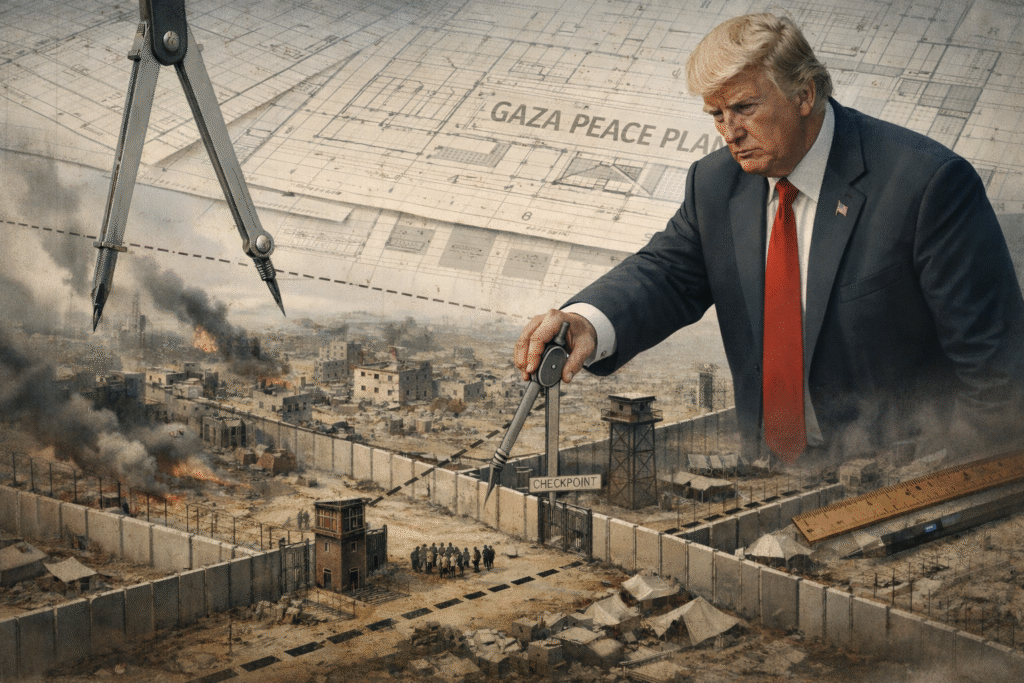
US President Donald Trump perpetually deems himself a global peacemaker for halting six wars, including the Israel–Hamas conflict. But the question arises whether Trump’s so-called 20-point peace plan, considered a harbinger of peace and stability in the Middle East, can permanently end the war in the war-torn region, or if it is merely a temporary pause in an unending conflict disguised as a ceasefire.
Trump’s Gaza Peace Proposal has garnered international criticism for excluding Palestinian stakeholders, shielding Israel’s sheer war crimes, and disregarding the Palestinian right to self-determination. According to analysts, the establishment of an international transitional technocratic government under the oversight body named the Board of Peace (BoP) is tantamount to the imposition of a foreign colonial rule, which outrightly undermines Palestinian sovereignty.
The Board of Peace (BoP) is a foreign-installed governance body chaired by Donald Trump and the notorious Tony Blair. It has been established to supervise a technocratic and apolitical committee responsible for administering, reconstructing, and demilitarising Gaza. The BoP is a wholly vague entity that lacks political legitimacy, plain selection criteria, and genuine Palestinian representation. Replacing Palestinian authority with such a body amounts to a new form of colonisation.
The United Nations Security Council passed a resolution endorsing Trump’s 20-point peace plan. Most surprisingly, the Palestinians and their stakeholders had no role in drafting the proposal; it was formulated without any Palestinian input. Hamas has unequivocally rebuffed the US-backed UN resolution, terming it a failure to address the Palestinians’ genuine grievances and an attempt to impose a foreign-enforced systemic mechanism to carry out Israeli objectives.
The inception of the International Stabilization Force (ISF), a multinational peacekeeping mission, tasked with delivering security and overseeing the ceasefire agreement in Gaza, is a brazen violation of Palestinian sovereignty. The ISF is controversial, as it is widely viewed as Western-backed and likely to solidify Israeli control rather than play a role of an impartial peacekeeping body. Excluding Palestinian stakeholders from the peacekeeping body raise concerns about the dubious role of the ISF.
What is more contentious is that the International Stabilization Force operates under the Board of Peace rather than the United Nations. It lacks a clear mandate, and its composition remains vague. Its role includes the demilitarisation of Gaza, making it more likely to function as an enforcement force fulfilling US-backed Israeli objectives. The ISF appears to be a combatting force rather than a peacekeeping force. It should instead be UN-mandated rather than operating under the already controversial BOP. It should also operates only at the borders, and that too in coordination with official Palestinian institutions.
At the beginning, numerous Muslim countries, including Indonesia and Azerbaijan, backed the peace plan but are now reconsidering sending troops to the International Stabilisation Force (ISF). Their key grievance is that they might be equipped with responsibility of confiscating the weapons of Hamas, which would be a dangerous display of confrontation and escalation. Disarming Hamas is equivalent to suppressing the resistance of the Palestinians. This peace plan is an organized ploy to pit Muslim countries and Palestinians against each other which requires careful reconsideration.
Deputy Prime Minister Ishaq Dar explained Pakistan’s stance by stating that the country is unwilling to demilitarise Hamas and confiscate its weapons. He made it crystal clear: “Demilitarizing Palestinian resistance is not our duty.” Egyptian Foreign Minister Dr. Badr Ahmed Mohamed Abdelat also stated that the mandate should be confined to overseeing the ceasefire, not disarming Hamas.
Neutralizing Palestinian resistance is tantamount to solidifying Israel’s control over Palestine. Pakistan should reconsider joining the ISF, as the force is designed to confront Hamas, not protect Palestinians. Given Israel’s perpetual ceasefire violations, Hamas will not give up its weapons, increasing the chances of military engagement between the ISF and Hamas, ergo, putting Pakistan in a security quagmire.
Without a clear roadmap for Palestinian statehood, war reparations, an outright end to Zionist occupation, a complete Israeli military withdrawal, and Israeli accountability for the Gaza genocide, backing Trump’s peace plan would be akin to undermining the larger interests of the Palestinians. Endorsing Trump’s colonialism dressed as diplomacy would demean the Palestinian cause and weaken the moral and diplomatic position of Muslim countries by favouring Israeli objectives and suppressing legitimate Palestinian resistance.
Disclaimer:
The views expressed in this article are those of the author and do not necessarily reflect the policy or position of the Global Stratagem Insight (GSI).