Survivable and Mobile: Why North Korea’s Missile Force Is Harder to Deter Than Before
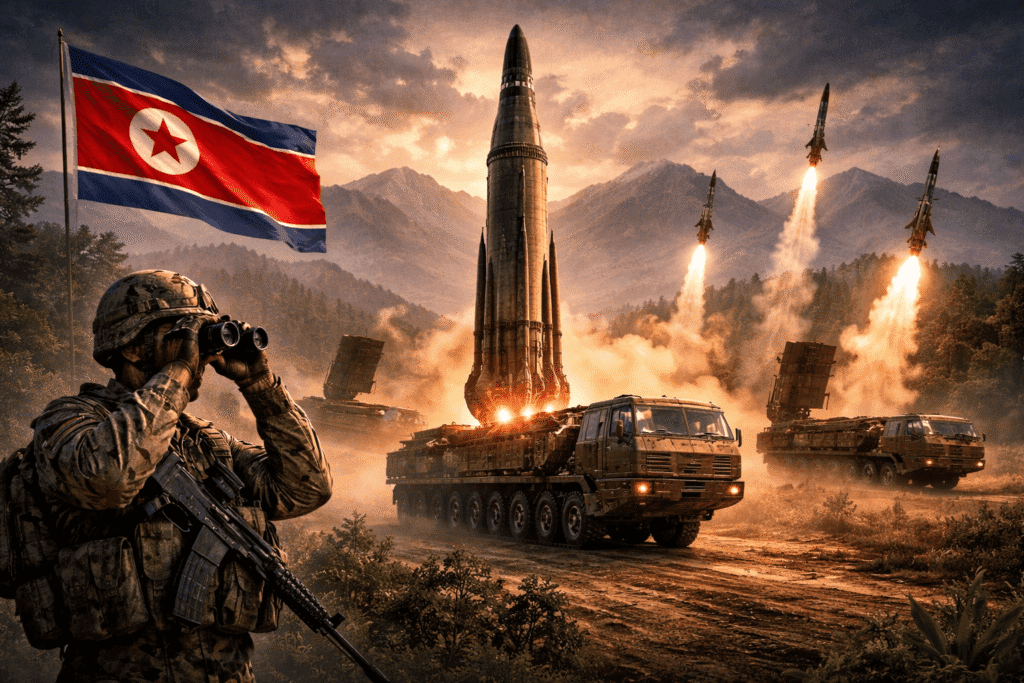
Mobile launchers, missile tests, and rugged terrain illustrate the growing survivability and operational flexibility of North Korea’s evolving missile force.
For much of the past two decades, deterrence on the Korean Peninsula relied on a relatively simple assumption: that North Korea’s nuclear forces were limited, vulnerable, and therefore containable through superior intelligence, surveillance, and conventional strike capabilities. That assumption is now increasingly outdated. Pyongyang’s evolving missile force characterized by mobility, survivability, and diversification has made deterrence more complex and crisis management more fragile than before.
At the center of this transformation are three interrelated developments: the widespread use of transporter-erector-launchers (TELs), the emergence of submarine-based nuclear delivery systems, and the growing difficulty of executing credible counterforce strategies. Together, these trends are reshaping the nuclear risk environment not only on the Korean Peninsula but across East Asia.
Mobility as a Strategic Equalizer
North Korea’s reliance on road-mobile missile systems has significantly improved the survivability of its nuclear arsenal. TELs allow missiles to be dispersed, concealed, and repositioned rapidly, complicating detection and targeting efforts. Unlike fixed silos or known launch sites, mobile platforms reduce the effectiveness of pre-emptive strikes and increase uncertainty during crises.
Open-source satellite imagery and defense assessments show that North Korea has invested heavily in expanding and modernizing its TEL fleet, including both domestically produced and modified heavy vehicles. According to analysis by the Center for Strategic and International Studies (CSIS), mobile missile units can operate from forested areas, tunnels, and hardened shelters, sharply reducing warning time for adversaries.
From a deterrence perspective, mobility enhances second-strike credibility. Even if an adversary believes it can neutralize part of North Korea’s missile force, the uncertainty surrounding the location and readiness of mobile launchers undermines confidence in a successful disarming strike. This uncertainty, in turn, raises escalation risks by incentivizing caution or, paradoxically, faster decision-making during crises.
Submarine-Based Systems and the Expansion of Survivability
Beyond road mobility, North Korea’s pursuit of submarine-launched ballistic missiles (SLBMs) represents a qualitative leap in force survivability. Although Pyongyang’s sea-based deterrent remains limited and technically constrained compared to established nuclear powers, its strategic significance lies less in scale and more in effect.
Submarine-based systems introduce a new domain of uncertainty. Even a small number of operational SLBMs complicates adversary planning by forcing resources to be diverted toward anti-submarine warfare and maritime surveillance. North Korea’s test launches of SLBMs in recent years signal an intent to move toward a more diversified and survivable nuclear posture.
The International Institute for Strategic Studies notes that sea-based deterrents, even when rudimentary, can meaningfully enhance second-strike assurance by increasing ambiguity around launch platforms and timelines. For regional actors, this means that North Korea’s nuclear forces can no longer be treated as predominantly land-based and geographically predictable.
Counterforce Becomes Less Credible
As North Korea’s missile force becomes more mobile and dispersed, the feasibility of counterforce strategies declines. Counterforce striking an adversary’s nuclear weapons before they can be used depends on accurate intelligence, timely decision-making, and confidence in strike effectiveness. Mobility and concealment undermine all three.
In practice, this creates a deterrence dilemma. If adversaries doubt their ability to eliminate North Korea’s nuclear forces in a first strike, they may place greater emphasis on missile defense and rapid retaliation. However, missile defenses themselves are imperfect and can introduce false confidence or escalation incentives, especially during high-pressure situations.
Research from the Carnegie Endowment for International Peace highlights how survivable nuclear forces tend to stabilize deterrence at a strategic level while simultaneously increasing crisis instability by compressing timelines and heightening worst-case assumptions. In the Korean context, this tension is particularly acute given the proximity of key military and civilian targets.
Implications for Regional Deterrence
North Korea’s increasingly survivable missile force has implications beyond the immediate US–DPRK dyad. South Korea and Japan are directly exposed to the evolving threat, prompting expanded investments in missile defense, strike capabilities, and alliance coordination. While these measures aim to restore deterrence credibility, they also contribute to a regional security environment marked by rapid military adaptation and mutual suspicion.
Shorter warning times, mobile launch platforms, and ambiguous deployment patterns increase the risk of misinterpretation. Routine military movements or exercises could be misread as preparations for launch, while intelligence gaps may encourage worst-case assessments. In such an environment, deterrence relies not only on capabilities, but on accurate interpretation of intent something that becomes harder as survivability increases.
A More Durable, But More Dangerous, Deterrent
North Korea’s pursuit of mobility and survivability reflects a rational response to its strategic environment. Faced with overwhelming conventional and technological asymmetry, Pyongyang has prioritized ensuring that its nuclear forces can endure and retaliate. In doing so, it has made its deterrent more durable.
Yet durability does not equal safety. A missile force that is harder to locate and neutralize reduces the likelihood of successful disarmament but increases the complexity of escalation control. Deterrence may hold, but it does so under greater stress, with fewer margins for error.
North Korea’s missile evolution has fundamentally altered the deterrence landscape in East Asia. Transporter-erector-launchers, submarine-based systems, and improved survivability have made its nuclear force harder to deter through traditional counterforce logic. The result is a strategic environment defined by uncertainty, compressed timelines, and heightened escalation risk.
Managing this challenge requires more than technological responses. It demands sustained open-source monitoring, careful assessment of indicators and anomalies, and realistic modelling of escalation pathways. As North Korea continues to prioritize survivability over restraint, the central question for regional security is no longer whether deterrence exists, but how stable it remains under growing pressure.