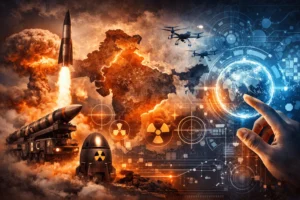
India’s Joint Doctrine for Cyberspace Operations: Implications for Crisis (In)Stability in South Asia
Fakhar Alam December 19, 2025
India’s Chief of Defence Staff (CDS) has released a Joint Doctrine for Cyberspace Operations (JDCO) during the Chiefs of Staff Committee meeting in August 2025. According to the Indian Ministry of Defence (MOD), the doctrine is aimed at outlining a national unified approach to defend India’s cyberspace interests while integrating defensive and offensive capabilities in synergy across all services of the Indian Armed Forces. This article analyzes key aspects of JDCO, including its operational objectives, the tools envisioned to achieve operational objectives and the types of operations the doctrine aims to conduct. Together, these analyses highlight the doctrine’s broader implications for the crisis (in)stability in South Asia.
The prime objective behind JDCO 2025 is to create a synergy between different legs of the Indian army, including land, air, sea and space, to produce an integrated response aimed at retaining its own freedom of action and denying the adversary’s freedom of action in cyberspace. The doctrine clearly envisions the development of a Credible Cyber Defensive Posture with the availability of both offensive and defensive cyber capabilities. The JDCO only focuses on the military aspects of cyberspace with the vision to establish Cyber Space Superiority during a crisis. It also acknowledges that any cyber-attack conducted in synergy or to support a conventional attack by an adversary will be considered as an armed attack on India and will be responded accordingly.
The doctrine states that the biggest utility of cyber power is its use as a weapon of information for cognitive operations and perception management. In the second chapter, under the heading of types of cyber operations, the doctrine lays out a detailed plan about Cyber Enabled Influence Operations. The document states that this type of operation involves deliberately using information to confuse and mislead the adversary to influence its choices as well as decision-making. To do that, it would involve the weaponization of information as a means for social engineering. The doctrine particularly highlights that social media platforms would be used to demoralize, paralyze, subvert, confuse and distract the adversary nation. It also envisioned that tools like deep fakes, bots and fake news will support the eventual weaponization of social media platforms to successfully conduct a Cyber Enabled Influence Operations.
A study shows that the public tends to believe rumors on social media more than real news. Repeatedly flowing of false information on media platforms results in the illusory truth effect. This effect can be described as people start considering false information as true if they are repeatedly exposed to false information start considering that false information as true. A similar phenomenon was observed during the post-Pahalgam India-Pakistan crisis, where a rumor regarding an Indian attack on Pakistan’s underground nuclear facility at Kirana Hills spread fast over media platforms. The illusory truth effect of these false events was so effective that, eventually, the military spokespersons from both sides had to officially deny these rumors. So, when the doctrine talks about the weaponization of information, it deliberately means employing a disinformation campaign. Such operations could be designed to undermine the people’s trust in national institutions, creating political division, undermining the credibility of the armed forces or the military capabilities, and causing chaos among the masses.
Given India’s track record since Narender Modi took office, false flag operations are justified as a pretext to launch an attack on Pakistan, evident from the February 2019 and May 2025 crises. What if the Indian military, under the Cyber Enabled Influence Operation, produces a deep fake of Pakistan’s Prime Minister or higher military leadership like Director General Inter Services Public Relations (ISPR), saying that Pakistan has initiated a strike against India or a particular Indian nuclear facility or nuclear storage depot, and injects this deep fake into social media during a crisis? And India, as usual, uses that video as a rationale to launch a missile towards Pakistan. Or an Indian military commander, after watching that video, launches, in patriotic emotion, a missile towards Pakistan, without official orders, like Brahmos was launched in March 2023.
Presently, from the masses to the political and military elite, everyone is embedded in and influenced by the social media ecosystem. It shapes narratives, influences the psyche and impacts rational decision-making. Employing a well-crafted disinformation campaign during a crisis can influence military or political leaders on either side to take aggressive action, leading to catastrophic outcomes. India’s JDCO, if practiced during a crisis, would not impact only the digital realm; rather, it has equal potential to create disastrous kinetic impacts in the physical domain. Disinformation campaigns supported by AI and tools like deep fakes, bots and fake news on social media platforms can have detrimental effects. Therefore, in a nuclearized region, JDCO can result in inadvertent escalation and further deteriorate already fragile crisis stability in South Asia.