
Europe’s Drone Defence Initiative: Drone Walls and the Changing Landscape of Defence
Zunaira Sarfraz December 12, 2025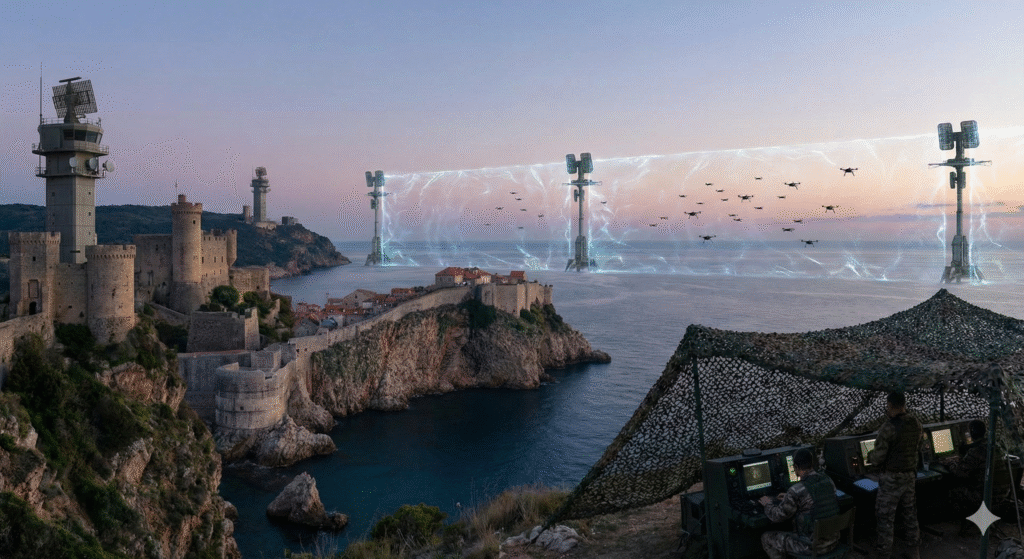
EU Drone Defence Initiative
When the Greeks wheeled a hollow wooden horse into Troy, it was not the biggest, costliest weapon, but the smartest one that won the ten-year siege of Troy for the Greeks. Today’s Trojan horse has motors, a camera and it flies in the skies: a drone. The low-cost drones, cheaper to employ than the traditional aerial weapons, have readily become the choice of weaker states. The growing use of unmanned aerial vehicles (UAVs) in the modern warfare is forcing adversarial states to rethink how they defend their skies. The Drone Defence Initiative of the European Union is a reflection of the changing defence policies responsive to the emerging threats.
Drone warfare is visible in every recent conflict: from the Armenian-Azerbaijan clashes to Iran-Israel strikes. The shift also reached South Asia as witnessed in the May 2025 Pakistan-India war. However, the first tactical use of drones, with mass quantities of UAVs fielded on the battlefield, was observed in the Ukraine war.
Bordering the Ukraine battlefield, the drone threats have reached Europe. In September 2025, border violations via drones were confirmed in a number of European countries, with at least ten countries reporting drone sightings over sensitive sites such as airports and military installations. The hybrid threat not only tested Europe’s air defence readiness but also posed significant psychological and economic costs. Following such incursions in its airspace, Poland imposed air-traffic restrictions on the eastern part of the country, leading to cancellation of civilian flights and closure of several airports leading to severe economic losses as well as public disarray.
The combination of the drone incursions, purportedly by Russia, alongside NATO’s failure to provide a cost-effective response to these threats further exposed European defence vulnerabilities. In light of these developments as well as keeping in mind President Trump’s repeated statements on recalibrating the US engagement in NATO, Europe upped its own defence investment. EU policy makers subsequently drafted a defence roadmap for the redressal of this increasing threat.
The European countries invoked Article 4 of the Washington Treaty, calling for NATO consultations, leading to the launch of a defence operation on the eastern border. The EU’s Defence Readiness Roadmap 2030, proposed in October 2025, was another realisation of the need for a responsive defence policy for these new challenges.
The Defence Readiness Roadmap proposes four flagship initiatives, one of which is the Drone Defence Initiative. This initiative exclusively deals with drone attacks, and aims to build a drone wall: an interoperable network of sensors to detect drone incursions, as well as electronic warfare tools and interceptor systems to counter drone attacks. The proposal essentially envisages a multi-layered drone defence system, designed to detect, track and neutralise unmanned threats. The operational capabilities are expected to be completed by the end of 2026, and fully functional by 2027.
The initiative, if successful, will boost Europe’s defence capabilities, driving confidence against the background of Russia’s border violations and NATO’s declining viability. Additionally, the initiative will boost Europe’s defence industry, benefiting major players in defence.
The plan, however, runs the risk of becoming hostage to bureaucratic, political and technical issues. The Defence Minister of Germany expressed scepticism over the drone wall, asserting that Europe needs to focus on broader defence capabilities. Moreover, Germany and France have both expressed concerns over a collective control of the initiative by the European Commission, calling instead for national-level control. If such remains the case, the fragmented, incompatible national system will undermine the effectiveness of a cohesive, continent-wide defence system against the Russian threat, exposing internal weaknesses inherent within the EU.
While the initiative is a timely response to the threat facing Europe, its effective employment requires more than just the drawing of a plan. The EU would need to first develop a political consensus to fight these new aerial threats collectively. Moreover, operational and economic feasibility needs to be addressed if countries opt for a sovereign control over the initiative.
From the cunning use of the wooden horse to the tactical deployment of drones in combat, history tells us that wars have repeatedly forced doctrinal change. The Drone Defence Initiative of the EU indicates that states are now filling the strategic flaws found in the traditional air defence systems, for exceptional threats demand exclusive response.
The lesson to be learnt from history, as well as from the recent EU initiative is that dealing with threats, whether medieval Trojan Horses or modern drones, requires an integrated approach. While the political will to act together may not exist in inter-state relations, intra-state integration of all involved state agencies is the need of the hour to deal with this emerging threat paradigm.